
Yes — many life insurance policies include living benefits that let you access funds while you’re still alive. These benefits come in two main forms: accelerated death benefit (ADB) riders that advance part of your death benefit when you’re diagnosed with a qualifying condition, and cash value built inside permanent policies that you can borrow against or withdraw at any time. Either path gives you money when a health crisis hits — but both reduce what your beneficiaries eventually receive, and some options add cost or require medical underwriting. Here’s what to weigh:
- Riders (ADB, critical illness, chronic illness, LTC): attached to term or permanent policies; triggered by a qualifying diagnosis or functional impairment
- Cash value (whole life, universal life): grows tax-deferred inside permanent policies; accessible via loans or withdrawals without a diagnosis
- Trade-off: any payout or loan reduces the death benefit and may carry tax consequences if the policy lapses
Roman-insurance, serving West Tennessee and the 38002 area, works with Allstate to help local residents find the right combination of riders and policy types for their situation.
Table of Contents
- How does life insurance with living benefits actually work?
- What types of living-benefit riders are available?
- How does cash value in permanent life insurance give you living benefits?
- What are the real costs and trade-offs of living benefits?
- How do you decide whether living benefits are right for you?
- What happens when you file a living-benefit claim?
- Key Takeaways
- The part most people get wrong about living benefits
- Roman-insurance can help you find the right living-benefit policy
How does life insurance with living benefits actually work?
Living benefits are policy features that provide access to funds while the insured is still alive — either through riders or through cash value in permanent policies. Understanding the mechanics of each path matters before you sign anything.
Path A: Living-benefit riders
A rider is a contract add-on that modifies what your policy pays and when. With an accelerated death benefit rider, the insurer advances a portion of your death benefit when you meet a defined trigger — typically a terminal diagnosis with a life expectancy of 12 months or less, though some contracts use 24 months. Critical illness and chronic illness riders work similarly but use different triggers: a heart attack, stroke, or cancer diagnosis for critical illness; an inability to perform a set number of Activities of Daily Living (ADLs) for chronic illness or long-term care riders.

The payout mechanics are straightforward. You submit a claim with physician documentation, the insurer reviews and certifies eligibility, and you receive either a lump sum or monthly payments depending on the rider type. That payout reduces the remaining death benefit dollar-for-dollar (or by a proportional percentage). Some riders are included in the base policy at no extra charge; others require a separate endorsement and added premium.
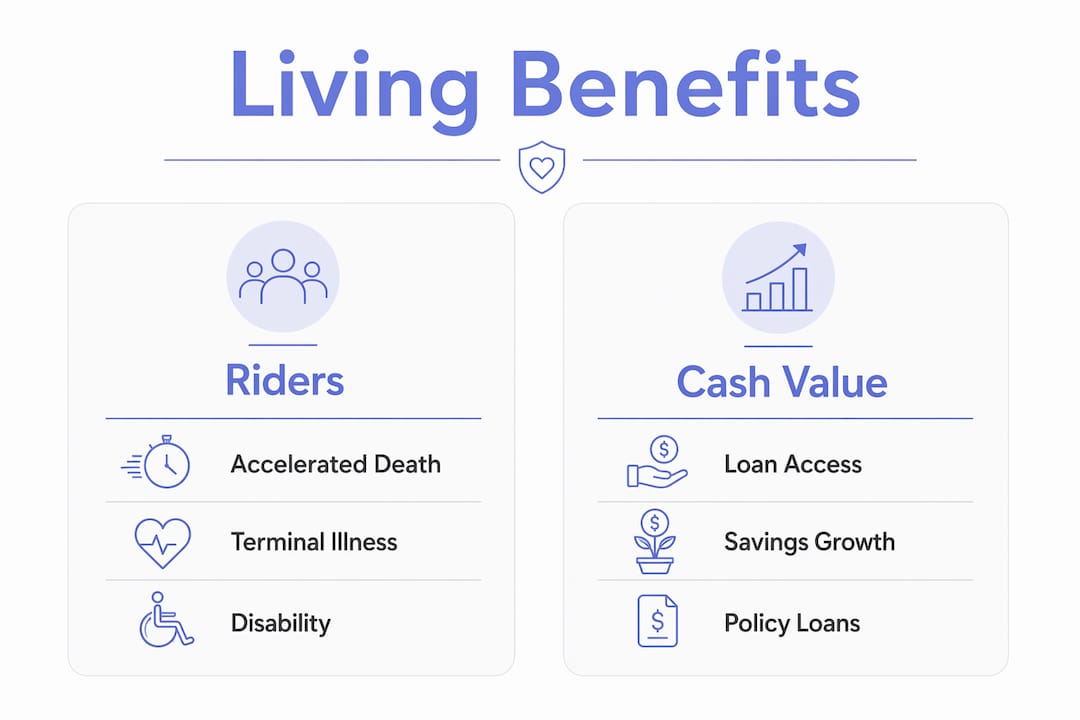
Funds received through living-benefit riders are generally discretionary — you can use them for medical bills, caregiving costs, or income replacement, not just hospital invoices.
Path B: Cash value in permanent policies
Whole life and universal life policies build a cash value account alongside the death benefit. That value grows tax-deferred over time and can be accessed three ways: a policy loan, a partial withdrawal, or full surrender. No diagnosis required. The catch is timing — cash value usually takes several years to grow into a sum worth borrowing against, so a brand-new permanent policy won’t help you next month.
Pro Tip: Some carriers include a terminal illness ADB rider at no extra premium — ask specifically whether it’s already built into any policy you’re quoting, because many buyers don’t realize it’s there until they need it.
What types of living-benefit riders are available?
The rider market has expanded significantly. Here’s what you’ll encounter and what each actually covers.
- Terminal illness / ADB rider: Triggered when a licensed physician certifies that the insured has a life expectancy of 12 months or less (some contracts say 24). Pays a lump sum — typically a percentage of the face amount — and reduces the death benefit by the same proportion. Often included at no added cost; a $150 administrative fee is common at the time of claim.
- Critical illness rider: Covers named conditions — usually heart attack, stroke, major organ failure, and certain cancers. Pays a lump sum or a fixed percentage of the death benefit upon diagnosis, regardless of life expectancy. Requires an added endorsement at most carriers.
- Chronic illness rider: Triggered by an inability to perform a specified number of ADLs (typically two of six) or a severe cognitive impairment. Can be structured as a lump-sum advance or monthly payments. Definitions vary enough between policies that comparing contract language matters more than comparing names.
- Long-term care (LTC) rider: Similar to chronic illness but specifically designed to cover ongoing care costs. LTC riders often pay monthly and may allow repeated draws until the available benefit pool is exhausted — a meaningful structural difference from one-time ADB payouts.
- Waiver of premium: Suspends your premium obligation if you become totally disabled, keeping the policy in force without out-of-pocket cost. Not a cash payout, but it preserves coverage during a health crisis.
- Return of premium: Refunds premiums paid if you outlive a term policy. Adds cost upfront but returns money at the end — a form of living benefit for the healthy.
| Rider | Typical trigger | Payout style | Effect on death benefit |
|---|---|---|---|
| Terminal illness / ADB | Life expectancy ≤ 12–24 months | Lump sum (% of face) | Reduced proportionally |
| Critical illness | Named diagnosis (heart attack, stroke, cancer) | Lump sum or fixed % | Reduced by amount paid |
| Chronic illness | 2+ ADL impairments or cognitive impairment | Lump sum or monthly | Reduced per payout |
| Long-term care rider | Ongoing ADL impairment | Monthly payments | Reduced per draw |
| Waiver of premium | Total disability | Premium suspension | No direct reduction |
| Return of premium | Policy outlived (term) | Refund of premiums paid | N/A (term policy ends) |
How does cash value in permanent life insurance give you living benefits?
Permanent life insurance — whole life and universal life being the most common — bundles a death benefit with a savings component. That savings component is the cash value, and it’s the second major source of living benefits.

Cash value grows tax-deferred, meaning you owe no income tax on the growth each year it sits inside the policy. The trade-off for that tax treatment is cost: permanent policies carry significantly higher premiums than comparable term coverage because part of every payment funds that savings account. For a deeper look at how cash value builds and compounds over time, the mechanics are worth understanding before you commit to a permanent policy.
Once enough value has accumulated — and this typically takes several years — you have three access methods:
- Policy loans: You borrow against the cash value at the insurer’s loan interest rate. The loan is generally non-taxable because you’re borrowing, not withdrawing. The policy stays in force, but the outstanding loan balance reduces the death benefit if you die before repaying it. If the policy lapses with a loan outstanding, the forgiven loan amount can become taxable income.
- Partial withdrawals: You pull cash directly out of the account. Withdrawals up to your cost basis (premiums paid) are typically tax-free; amounts above that basis may be taxable. Unlike loans, withdrawals permanently reduce cash value and the death benefit.
- Surrender: You cancel the policy entirely and receive the remaining cash value minus any surrender charges. The death benefit disappears. Any amount above your cost basis is taxable.
Tax treatment depends on the amount and policy status; complex holdings warrant a conversation with a tax advisor before you exercise any benefit.
Pro Tip: Policy loans work best for short-term liquidity needs when you plan to repay — they preserve the death benefit and keep dividends or interest crediting intact. Withdrawals make more sense when you’re certain you don’t need that coverage amount long-term. Surrender is rarely the right move unless the policy has fundamentally stopped serving its purpose.
What are the real costs and trade-offs of living benefits?
Living benefits aren’t free, and the cost structure isn’t always obvious from a quote sheet.
- Rider premiums: Terminal illness riders are sometimes included at no additional cost, but critical illness, chronic illness, and LTC riders typically require added endorsement fees. Those fees compound over a 20- or 30-year policy life.
- Higher base premiums for permanent policies: The cash-value component drives premiums well above equivalent term coverage. That gap is the price of the savings and access flexibility — worth it for some goals, not for others.
- Reduced death benefit after payout: Every dollar advanced through a rider or withdrawn from cash value is a dollar your beneficiaries don’t receive. A 50% ADB payout on a $100,000 policy leaves $50,000 for heirs.
- Waiting periods and elimination periods: Some chronic illness and LTC riders include a waiting period before benefits begin — often 90 days of qualifying impairment. That’s not a small gap if care costs start immediately.
- Loan interest and lapse risk: Policy loans accrue interest. If you don’t manage the balance, interest can erode the cash value to the point where the policy lapses — and a lapsed policy with outstanding loans can trigger a taxable event on the forgiven debt.
- Surrender charges: Many permanent policies carry surrender charges for the first 10–15 years. Accessing cash value via surrender during that window costs you a percentage of the value.
Pro Tip: Start by asking whether a no-cost ADB rider is already included in any policy you’re considering. If it is, you’ve gained meaningful protection at zero incremental cost. From there, compare the total cost of term plus a standalone critical illness policy against a permanent policy with embedded riders — the math often surprises people.
How do you decide whether living benefits are right for you?
Living benefits aren’t a universal add-on. They fit some situations well and others poorly.
Criteria to weigh before you buy:
- Health status and family history: If your family carries a history of cancer, heart disease, or early cognitive decline, chronic illness and critical illness riders address a real statistical risk.
- Existing coverage gaps: Do you already have long-term care insurance or disability coverage? If yes, some living-benefit riders duplicate protection you’re already paying for elsewhere.
- Liquidity needs: Cash-value access suits people who want a policy that doubles as a financial asset. Riders suit people who want targeted protection against specific health events without the higher permanent-policy premium.
- Estate and legacy goals: Permanent policies with cash value serve estate planning and wealth transfer goals that term policies with riders simply can’t replicate. For families thinking about life insurance as a legacy tool, the permanent route often makes more sense.
- Budget: Riders on a term policy cost less upfront. Permanent policies cost more but build value. Neither is wrong — the right answer depends on what you’re trying to accomplish.
Questions to bring to your agent:
- Is an accelerated death benefit rider already included in this policy, or is it optional?
- What specific diagnoses or functional impairments trigger each rider?
- Are there waiting periods or elimination periods before benefits begin?
- How exactly does a payout affect the remaining death benefit and premium?
- Are the riders portable if I convert from term to permanent coverage?
- What’s the life-expectancy definition in this contract — 12 months or 24?
- How does a policy loan affect dividends or interest crediting in this specific policy?
Decision triggers:
- Choose permanent with cash value when wealth accumulation, tax-deferred growth, or estate transfer is a primary goal.
- Choose term with riders when you need maximum death benefit per premium dollar and targeted living-benefit protection for a defined period.
- Choose standalone LTC or disability insurance when your living-benefit need is primarily long-term care or income replacement — dedicated products often provide richer benefits than riders at comparable cost.
Seniors evaluating these trade-offs will find the life insurance options for seniors breakdown useful for narrowing the field.
What happens when you file a living-benefit claim?
Accessing living benefits isn’t automatic on diagnosis. There’s a formal process, and knowing it in advance prevents delays when time matters most.
Documentation you’ll need:
- Completed claim form from the insurer
- Physician certification of the qualifying condition (terminal prognosis, specific diagnosis, or ADL assessment)
- Supporting medical records: test results, specialist reports, treatment history
- Policy documents and any rider endorsements
- Beneficiary notification may be required depending on the insurer and state
Typical claim timeline:
- Notify the insurer (Day 1–3): Call or submit online; request the living-benefit claim packet.
- Gather and submit medical documentation (Days 4–30): Physician certification is the most time-consuming step — your doctor must complete insurer-specific forms, not just provide a letter.
- Insurer review and eligibility determination (Days 30–60): The insurer may request an independent medical examination for large claims or ambiguous diagnoses.
- Approval and payment (Days 60–90): Lump-sum payments typically arrive within days of approval; monthly LTC rider payments begin on the next scheduled cycle.
The life-expectancy definition in your contract — 12 months versus 24 months — directly affects when you can file. A 24-month threshold gives you more runway; a 12-month threshold means you may need to be further along in a terminal illness before you qualify. Read that clause before you need it.
What speeds approval: a clear, well-documented physician statement that matches the contract’s exact trigger language. What causes delays: vague prognosis letters, missing test results, or a diagnosis that doesn’t map cleanly to the rider’s defined conditions.
Key Takeaways
Life insurance with living benefits gives you real financial flexibility during a health crisis, but the value depends entirely on which riders you carry, how your policy is structured, and whether you’ve matched the benefit type to your actual risk.
| Point | Details |
|---|---|
| Riders vs. cash value | Riders advance part of the death benefit on a qualifying event; cash value in permanent policies is accessible anytime without a diagnosis. |
| Cost and trade-offs | Terminal illness ADB riders are sometimes included at no extra cost; critical, chronic, and LTC riders typically add premium and reduce the death benefit on payout. |
| Claims require documentation | Accessing living benefits requires a formal claim, physician certification, and supporting medical records — not just a diagnosis. |
| Tax treatment matters | ADB payouts are generally tax-free at the federal level; policy loans can trigger taxable income if the policy lapses with an outstanding balance. |
| Roman-insurance local option | Roman-insurance works with Allstate to help West Tennessee residents compare rider options and permanent policy illustrations — contact the agency for a personalized review. |
The part most people get wrong about living benefits
Living benefits get marketed as a safety net that covers everything — and that framing sets people up for disappointment. The honest picture is narrower and more useful.
Riders are excellent at what they’re designed for: providing a financial buffer when a specific, defined health event occurs. A terminal illness ADB rider on a $500,000 policy can mean the difference between spending your final months managing debt and spending them with your family. That’s not a small thing. But riders are not long-term care insurance, and they’re not disability income replacement. A chronic illness rider that pays a lump sum once is a very different product from a dedicated LTC policy that pays monthly for years. Treating them as equivalent is where buyers get burned.
The cash-value side has its own misunderstanding. People hear “tax-deferred growth” and “policy loans” and assume a permanent policy is a savings account with a death benefit attached. It’s not — it’s a death benefit with a savings component attached, and the cost structure reflects that priority. If your primary goal is accumulation, there are more efficient vehicles. If your goal is a death benefit that also builds accessible value over decades while supporting legacy planning, permanent life makes sense. That distinction is worth being honest about before you commit to 20 years of higher premiums.
The portfolio approach — combining permanent coverage for tax-deferred accumulation with targeted riders for acute health risk — is what experienced agents actually recommend. It’s not a single product doing everything; it’s the right tool for each job. High-value clients in West Tennessee who are also thinking about wealth preservation strategies often find this layered approach fits their planning goals better than any single policy could.
Roman-insurance can help you find the right living-benefit policy
West Tennessee residents within 10 miles of 38002 have a local Allstate agency that can run the actual numbers — not just explain the concepts.

Roman-insurance works with Allstate to pull term versus permanent illustrations side by side, price riders as line items so you can see exactly what each adds to your premium, and map your living-benefit needs to your budget. Whether you’re a parent planning a legacy transfer, a homeowner looking for broad protection with a no-cost ADB, or a senior weighing LTC rider options, the agency can walk through the trade-offs in a single conversation. In-person appointments are available in West Tennessee, and phone or online quotes are just as easy. Start with a life insurance policy review or check senior-specific options to see what fits your situation before your next agent call.
Authoritative sources and further reading
- Aflac: Living Benefits of Life Insurance — Clear definitions of rider types and payout structures, including LTC monthly payment mechanics.
- Guardian: Living Benefits — Covers cash-value access methods, tax-deferred growth, and the portfolio approach to combining riders with permanent coverage.
- NerdWallet: Life Insurance With Living Benefits — Practical overview of when living benefits are worth it and when standalone LTC or disability products fit better.
- Investopedia: Accelerated Death Benefit — Detailed explanation of ADB mechanics, typical tax treatment, and how payouts reduce the death benefit.
- MassMutual: Living Benefits in a Life Insurance Policy — Covers which riders are typically included at no cost, tax considerations, and lapse risk with outstanding loans.
- New York Life: Living Benefit Riders — Explains the certification process, contract definitions for terminal and chronic conditions, and timing considerations for filing a claim.
This article is general information, not professional legal, tax, or financial advice. Confirm current rules and policy terms with a qualified professional or your state’s insurance department before making coverage decisions.