
You can get life insurance without a medical exam, and approval can come within 24 hours. No blood draws, no nurse visits, no waiting weeks for lab results. These policies use health questionnaires and third-party data to assess your risk, and for most healthy applicants under 50, the cost difference runs just 5%–10% more than a fully underwritten policy. That is a small price for a process that takes minutes instead of months.
What is life insurance with no medical exam?
Life insurance with no medical exam is exactly what it sounds like: a policy you can apply for and receive without scheduling a physical, giving blood, or sitting through a paramedical appointment. Instead of a nurse visit, the insurer asks you a set of health questions and then pulls data from sources like prescription history databases and Medical Information Bureau (MIB) records to fill in the picture.
The key benefits come down to three things:
- Speed: Many applicants receive a decision the same day they apply, with electronic policy delivery often within 24 hours.
- Simplicity: The application is typically completed online with no appointments to schedule.
- Accessibility: People with certain pre-existing conditions, a fear of needles, or demanding schedules can still get covered.
The main policy types offering this option include term life, whole life, simplified issue, and guaranteed issue. Each works differently, and the right fit depends on your age, health, and how much coverage you need.
Cost note: No-exam rates average $50 per month for women and $63 per month for men at age 40, for a nonsmoker seeking $500,000 in coverage on a 20-year term. That is a modest premium over fully underwritten policies for the convenience of skipping the exam entirely.
How no-exam life insurance works
The underwriting process behind a no-exam policy replaces physical tests with data. When you apply, the insurer collects your health history through a detailed questionnaire covering tobacco use, recent diagnoses, medications, and lifestyle factors. Then, rather than ordering lab work, the carrier pulls third-party records automatically.
Those external sources typically include:
- Prescription history databases: Reveal what medications you take and for what conditions.
- MIB records: A shared database insurers use to flag inconsistencies in prior applications.
- Motor vehicle reports: Driving history signals risk behavior beyond just car accidents.
- Other approved data points: Some carriers also check credit-based insurance scores or public records.
Most applicants receive one of three outcomes: approved, approved at a specific rate class, or referred for additional review. That last outcome is where a medical exam might still enter the picture. If the third-party data raises a flag or your desired coverage amount exceeds the carrier’s no-exam threshold, the insurer can request a traditional paramedical exam before issuing the policy.
Accelerated underwriting, the digital model most carriers now use, enables instant decisions for applicants with clean health histories. The whole process happens electronically: you apply, the system checks the databases, and the policy arrives in your inbox. For straightforward cases, that timeline is often under 24 hours.

Types of no-exam life insurance policies
No-exam coverage comes in four distinct forms, each with different underwriting requirements, coverage limits, and costs.
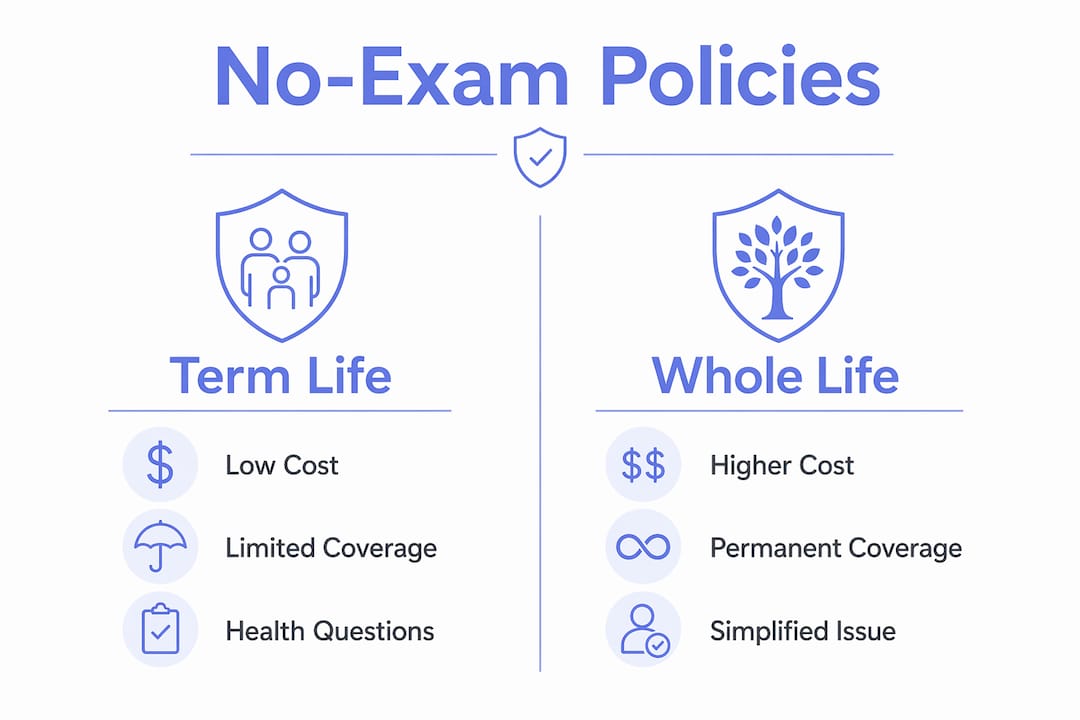
- Term life (no exam): Covers you for a set period, typically 10, 20, or 30 years. Premiums stay level throughout the term. It is usually the most affordable no-exam option and works well for income replacement or mortgage protection.
- Whole life (no exam): Provides lifelong coverage as long as premiums are paid. The death benefit is guaranteed, and many policies build cash value over time. Costs more than term, but the coverage never expires.
- Simplified issue: Requires answering a short health questionnaire but skips the physical exam. Approval is not guaranteed, but the bar is lower than fully underwritten policies. Coverage limits are moderate.
- Guaranteed issue: No health questions at all. Anyone who applies within the eligible age range gets approved. The trade-off is higher premiums and lower coverage amounts, typically capped at $25,000–$50,000. These policies often include a two-year graded death benefit, meaning the full payout only kicks in after the policy has been active for two years.
| Policy Type | Typical Coverage Limit | Health Questions? | Relative Cost | Best For |
|---|---|---|---|---|
| Term life (no exam) | Up to $3 million+ | Yes, detailed | Lowest | Income replacement, mortgage protection |
| Whole life (no exam) | Varies by carrier | Yes, moderate | Moderate to high | Lifelong coverage, estate planning |
| Simplified issue | Up to $500,000 | Yes, brief | Moderate | Moderate health concerns, quick coverage |
| Guaranteed issue | $25,000–$50,000 | None | Highest | Serious health conditions, final expenses |
Coverage caps vary widely across carriers. Some insurers cap no-exam policies at $250,000, while others go up to $3 million. Penn Mutual stands out with a no-exam limit of $10 million, though that is an outlier. If you need more than $1 million in coverage, confirming the carrier’s cap before applying saves time.
Who should choose no-exam life insurance?
No-exam policies fit a specific set of circumstances well, and knowing whether you fall into that group saves you from overpaying or underbuying.
Ideal candidates include:
- People who need coverage fast, such as those finalizing a mortgage, starting a business, or filling a gap after a group policy ends.
- Applicants with a fear of needles or medical settings who have been putting off getting covered.
- Those with some pre-existing conditions who may still qualify for simplified issue coverage.
- Smokers or people in high-risk occupations who want basic protection without a lengthy underwriting process.
- Busy professionals who cannot schedule a paramedical appointment during business hours.
Age and health status shape the math significantly. Younger, healthier applicants get the best rates on no-exam policies and lose the least ground compared to fully underwritten coverage. As you age or if your health history gets more complex, the premium gap between no-exam and traditional policies tends to widen.
Traditional fully underwritten policies make more sense when you need a large death benefit, say $2 million or more, and your health is good enough to qualify for preferred rates. In that case, the exam can actually save you money. The same logic applies if you are in excellent health and have time to wait: a full underwriting process often rewards healthy applicants with lower premiums than any no-exam product can match.
Pro Tip: If you are unsure which path to take, get quotes for both. The premium difference will tell you quickly whether the convenience of skipping the exam is worth the cost.
Pros and cons of life insurance with no medical exam
No-exam policies solve a real problem for a lot of people, but they come with trade-offs worth understanding before you commit.
Advantages:
- Faster approval, often within 24 hours for straightforward applications.
- No scheduling, no blood draws, no nurse visits.
- Accessible to applicants with some health conditions who might struggle with traditional underwriting.
- Fully digital process from application to policy delivery.
- Claim payouts work the same as standard life insurance; quick underwriting does not reduce payout guarantees.
Disadvantages:
- Premiums run 5%–10% higher than fully underwritten term life for healthy applicants.
- Coverage limits are lower. Most carriers cap no-exam policies well below what a traditional policy can offer.
- If the third-party data raises concerns, the insurer can still require a medical exam before issuing coverage.
- Guaranteed issue policies include a graded death benefit period, which limits the payout if you die within the first two years.
- Less medical information means insurers price in more uncertainty, which shows up in the premium.
The claim process itself does not change. Beneficiaries file a claim the same way they would with any life insurance policy, and accurate disclosures during the application remain critical. Misrepresenting your health history can give the insurer grounds to deny a claim, regardless of whether an exam was required.
Cost considerations for no-exam life insurance
Pricing on no-exam policies follows the same core variables as any life insurance: age, gender, health status, coverage amount, and term length. The difference is that without an exam, the insurer has less precise data, so they build a small buffer into the rate.
For a 40-year-old nonsmoker with average health seeking $500,000 on a 20-year term, average monthly rates come in at $50 for women and $63 for men. The gender gap exists because women statistically live longer, which lowers their actuarial risk. That gap widens at some carriers and narrows at others, so shopping across multiple providers matters.
| Age | Gender | $250,000 / 20-Year Term | $500,000 / 20-Year Term |
|---|---|---|---|
| 30 | Female | Lower end of market | ~$30–$40/mo |
| 30 | Male | Lower end of market | ~$38–$50/mo |
| 40 | Female | Moderate | ~$50/mo avg |
| 40 | Male | Moderate | ~$63/mo avg |
| 50 | Female | Higher | Significantly more |
| 50 | Male | Higher | Significantly more |
Note: Figures for age 40 come from MoneyGeek’s 2026 analysis. Ranges for other profiles are illustrative; get carrier quotes for your specific situation.
Coverage caps affect cost in a less obvious way. Carriers that limit no-exam policies to $250,000 or $300,000 are effectively pushing higher-need applicants toward fully underwritten products. If you need $1 million or more, your no-exam options narrow quickly, and the carriers that do offer that coverage tend to charge more for it. Checking coverage limits before you apply avoids wasted time on policies that cannot meet your needs.
For West Tennessee residents, Roman-insurance can help you compare life insurance rates in Memphis and the surrounding area, including no-exam options through Allstate.
How to improve your chances of approval without a medical exam
No-exam does not mean no scrutiny. The insurer still builds a risk profile from your application and third-party data, so how you present your information matters.
Be accurate and complete on the health questionnaire. Insurers cross-reference your answers against prescription databases and MIB records. Inconsistencies trigger manual review and can lead to a declined application or, worse, a denied claim later. Honesty is not just ethical here; it is practical.
Disclose medications accurately. Prescription history is one of the first things carriers check. If you take medication for a managed condition like high blood pressure or cholesterol, say so. Many carriers price that in without denying coverage. Omitting it creates a red flag when the database check runs.
Apply at the right time. Recent diagnoses, recent surgeries, or recent changes in medication can push an application into manual review. If your health situation has been stable for a year or more, your profile looks cleaner to an automated underwriting system.
Choose the right policy type for your health profile. If you have a significant health history, simplified issue or guaranteed issue policies are built for you. Applying for a no-exam term policy with a complex health background often results in referral for a full exam anyway. Matching the product to your profile from the start saves time.
Keep your coverage request within the carrier’s no-exam limit. Requesting $2 million from a carrier that caps no-exam coverage at $500,000 will not result in a $2 million no-exam policy. It will result in a referral to traditional underwriting. Know the cap before you apply.
Alternatives to no-exam life insurance
No-exam policies are not the only option for people who want coverage without a lengthy process. A few alternatives are worth knowing.
Fully underwritten term life insurance takes longer, typically two to six weeks, but rewards healthy applicants with lower premiums and higher coverage limits. If your health is good and you are not in a rush, this path often costs less over the life of the policy.
Group life insurance through an employer usually requires no medical exam at all for the base coverage amount. The trade-off is that coverage ends when employment ends, and the death benefit is often capped at one or two times your annual salary. It works as a supplement but rarely as a standalone solution.
Accidental death and dismemberment (AD&D) insurance pays out only if death or injury results from an accident. No health questions, no exam, and premiums are low. The limitation is significant: illness, which accounts for the majority of deaths, is not covered.
Final expense insurance is a form of whole life insurance with small death benefits, typically $5,000–$50,000, designed to cover funeral costs and end-of-life expenses. Underwriting is minimal or nonexistent. Premiums are high relative to the coverage amount, but it fills a specific gap for older applicants or those with serious health conditions.
Each of these alternatives serves a different need. The right choice depends on your health, your budget, and what you actually need the policy to do. Roman-insurance works with clients across West Tennessee to find the right fit, whether that is a no-exam policy or a traditional product. Get a quote to see what your options look like.

Key Takeaways
No-exam life insurance costs 5%–10% more than fully underwritten coverage but delivers approval in as little as 24 hours, making it the right trade-off for most applicants who value speed and simplicity over the lowest possible premium.
| Point | Details |
|---|---|
| Average cost at age 40 | $50/month for women, $63/month for men at $500,000 on a 20-year term. |
| Underwriting method | Carriers use health questionnaires, prescription databases, and MIB records instead of physical exams. |
| Coverage caps vary widely | Most carriers cap no-exam policies at $3 million or less; some may limit coverage to $250,000 or $500,000. Penn Mutual offers up to $10 million, but that is an outlier; confirm limits before applying. |
| Four policy types available | Term, whole life, simplified issue, and guaranteed issue each suit different health profiles and needs. |
| Honesty on applications matters | Accurate disclosures protect your beneficiaries; misrepresentation can lead to a denied claim. |