Tennessee homeowners typically pay around $3,045 per year for a policy with $250,000 in dwelling coverage, which works out to roughly $254 per month, according to MoneyGeek’s statewide estimates. That figure is a useful starting point, but your actual premium can land meaningfully higher or lower depending on where you live, how old your roof is, your credit-based insurance score, and how much dwelling coverage you actually need. A homeowner in Memphis with an older roof and a prior claim will see a very different number than a claim-free homeowner in a newer Germantown subdivision.
The fastest way to find your real number: get quotes from at least three insurers and compare them on identical coverage terms. Contact a local Roman-insurance agent for an apples-to-apples comparison specific to your ZIP code.
Key variables that move the price:
- Dwelling coverage limit (the single biggest driver)
- ZIP code and city (tornado exposure, flood zone, local fire protection)
- Roof age and material
- Credit-based insurance score
- Claims history (even one claim can raise your rate for years)
- Deductible level
Key Takeaways
Tennessee homeowners insurance costs around $3,045 per year for $250,000 in dwelling coverage, but your actual premium depends on your ZIP code, roof age, credit score, and claims history.
| Point | Details |
|---|---|
| Statewide average cost | About $3,045/year ($254/month) for $250,000 dwelling coverage; higher limits push premiums meaningfully higher. |
| Biggest cost drivers | Dwelling limit, roof age, ZIP code risk, and credit-based insurance score move your premium the most. |
| Top ways to save | Bundle home and auto, raise your deductible, and update your roof for the most reliable premium reductions. |
| Critical coverage gap | Flood and sewer backup are excluded from standard policies; add a sewer endorsement and price NFIP flood coverage separately. |
| Roman-insurance local service | Roman-insurance is a West Tennessee Allstate agency near 38002 offering apples-to-apples homeowners quotes and bundled savings. |
Table of Contents
- What does a standard Tennessee homeowners policy cover?
- How much does homeowners insurance cost in Tennessee by coverage level?
- What factors push your Tennessee premium up or down?
- What does a standard Tennessee policy NOT cover?
- How do you estimate your Tennessee homeowners premium?
- Practical ways to lower your Tennessee homeowners premium
- Optional endorsements Tennessee homeowners should consider
- What to expect from quote request to bound policy
- How the cost numbers in this article were estimated
- A local agent’s perspective on Tennessee pricing surprises
- Get a Tennessee homeowners quote from Roman-insurance
- Sources
What does a standard Tennessee homeowners policy cover?
A standard HO-3 policy, which is what most Tennessee homeowners carry, bundles six coverage types. Understanding each one matters because the dwelling limit you set for Coverage A determines your premium more than almost anything else.
- Coverage A — Dwelling: Pays to rebuild your home’s structure after a covered loss. Set this to your home’s replacement cost, not its market value or what you paid for it.
- Coverage B — Other structures: Covers detached garages, fences, and sheds, typically at 10% of your dwelling limit by default.
- Coverage C — Personal property: Covers furniture, electronics, clothing, and other belongings, usually at 50–70% of the dwelling limit. Standard policies reimburse at actual cash value unless you add a replacement-cost endorsement.
- Coverage D — Loss of use: Pays for hotel and living expenses if a covered loss makes your home temporarily uninhabitable.
- Coverage E — Liability: Protects you if someone is injured on your property and sues. Standard limits start at $100,000, but $300,000 or more is worth considering for most homeowners.
- Coverage F — Medical payments: Covers minor medical bills for guests injured on your property, regardless of fault. Limits are typically $1,000–$5,000.
The dwelling limit is the lever that controls most of what you pay. Insurers use replacement cost, not market value, as the correct base. Fall below that threshold and your insurer may apply a proportional penalty or pay only actual cash value, per MoneyGeek’s calculator guidance.
Pro Tip: Schedule high-value items like jewelry, fine art, firearms, and musical instruments separately. Standard Coverage C limits for jewelry often cap at $1,500–$2,500 per item. Keep photos, receipts, and appraisals in a secure digital folder so claims go smoothly. Roman-insurance can connect you with insurance for high-value items if your collection warrants a separate floater.
How much does homeowners insurance cost in Tennessee by coverage level?
The table below shows illustrative annual and monthly premium ranges for three common dwelling coverage levels, based on a baseline profile: single-family home, $1,000 deductible, no claims in the past five years, average credit class, standard construction. These are scenario estimates to help you calibrate expectations. Your actual quote will vary by ZIP, insurer, home age, and specific features.
Insure.com’s Tennessee data confirms the statewide average near $3,045 annually for a $250,000 dwelling profile and shows meaningful ZIP-level spread across the state. NerdWallet’s analysis reinforces that the gap between the cheapest and most expensive insurer for the same profile can reach several thousand dollars per year, which is exactly why comparing multiple quotes matters.
City and ZIP code shift these numbers considerably. Memphis-area homeowners often pay more than the statewide average due to higher crime rates and older housing stock. Germantown and Collierville tend to run closer to or below the average for comparable coverage levels, partly because of newer construction and stronger local fire protection ratings.
A note on published averages: Different sources use different sample profiles, dwelling limits, and credit tiers to calculate their “average.” MoneyGeek, Insure.com, and NerdWallet all arrive near $3,045 for a $250,000 dwelling profile, but their numbers diverge at higher coverage levels. Always treat published averages as a directional benchmark, not a quote.
What factors push your Tennessee premium up or down?
Insurers don’t set your rate arbitrarily. They run your home’s characteristics through a pricing model that weighs several variables simultaneously. Here’s how the major ones work in practice.
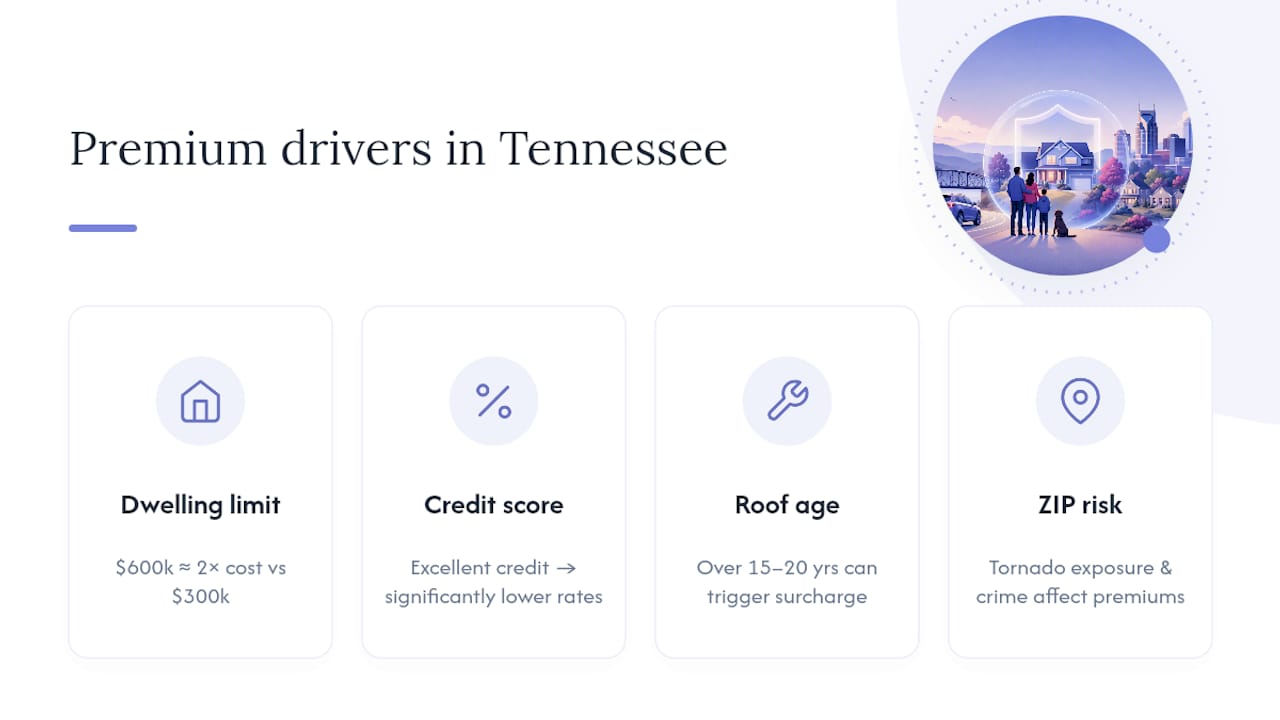
Dwelling coverage limit and replacement cost are the foundation. A $600,000 dwelling limit costs roughly twice as much to insure as a $300,000 limit, all else equal. Getting the replacement cost right matters: overinsure and you pay more than necessary; underinsure and you face a penalty at claim time.
Deductible level has a direct, predictable effect.
ZIP code and city risk reflect tornado exposure, flood zone proximity, local crime rates, and fire protection class. Tennessee averaged about 31 tornadoes per year between 1995 and 2024, and that storm exposure is priced into premiums across the state, especially in West Tennessee. Local burglary rates also factor into personal property pricing.
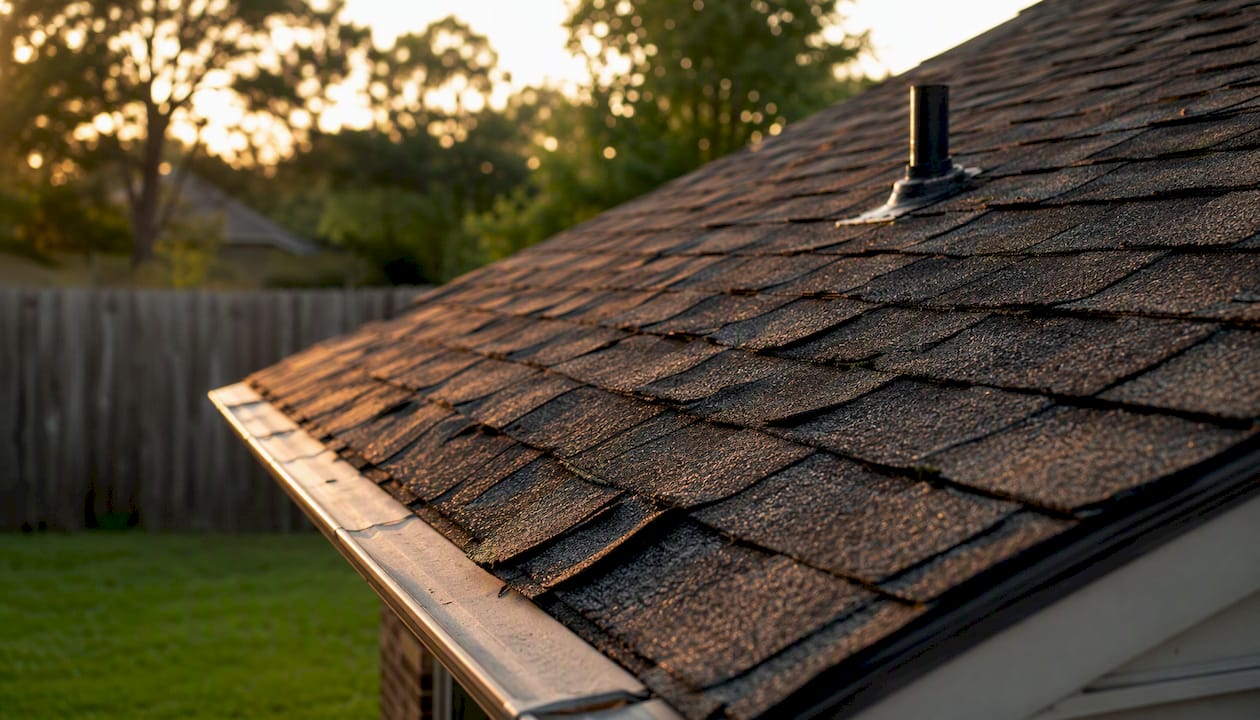
Roof age and material are among the most scrutinized factors at underwriting. A roof over 15–20 years old can trigger a surcharge or even a coverage restriction. Metal and impact-resistant shingles often qualify for discounts. Asphalt shingles past their warranty period are a red flag for many carriers.
Home age and construction type matter because older homes often have outdated wiring, plumbing, and HVAC systems that increase the likelihood of a claim. Brick construction typically rates better than wood frame for fire risk.
Credit-based insurance score is legal in Tennessee and widely used. Homeowners with excellent credit can pay significantly less than those with fair or poor credit for identical coverage. The MoneyGeek calculator shows credit tier as one of the top premium drivers.
Claims history follows you. A single claim can raise your Tennessee premium by several hundred dollars annually and that surcharge can persist for up to five years. Filing small claims, particularly under $2,000, often costs more in premium increases than the claim pays out.
Local fire protection class (ISO rating) reflects how close your home is to a fire station and hydrant. Rural properties far from fire services pay more.
Pro Tip: Before you request a quote, verify your roof’s age and material from your permit records or a recent inspection report. Agents frequently discover that homeowners have the wrong roof year on file, which causes rate surprises at bind time or policy renewal.
What does a standard Tennessee policy NOT cover?
Standard HO-3 policies exclude several perils that are genuinely relevant to Tennessee homeowners. Knowing the gaps before you need to file a claim is the whole point.
Flood damage is the most consequential exclusion. A standard homeowners policy covers zero flood damage, regardless of cause. Flood insurance is purchased separately through the National Flood Insurance Program via FloodSmart or through private flood carriers. If your home is in a FEMA-designated Special Flood Hazard Area, your mortgage lender will likely require it. Even outside flood zones, the real cost of flooding can be severe: FEMA data shows that just one inch of water can cause tens of thousands of dollars in damage.
Earthquake damage is excluded from standard policies. Tennessee sits near the New Madrid Seismic Zone, one of the most seismically active regions in the central United States. Earthquake endorsements or separate policies are available but not widely purchased, which is a coverage gap worth discussing with your agent.
Sewer and sump pump backup is excluded unless you add a specific endorsement. This is one of the most common claims Tennessee homeowners file and one of the most commonly overlooked gaps. Older sewer lines in Memphis and surrounding areas make this endorsement particularly worth adding. Roman-insurance has a detailed breakdown of sewer insurance coverage for Tennessee homeowners.
Mold is typically limited or excluded unless it results directly from a covered peril. Gradual water damage and maintenance-related mold are almost always excluded.
Wear and tear, mechanical breakdown, and gradual deterioration are never covered. Policies pay for sudden, accidental losses, not deferred maintenance.
Wildfire is covered under standard HO-3 policies as a named peril, but the Insurance Information Institute notes that wildfire risk is growing in parts of East Tennessee, and some insurers are tightening underwriting in higher-risk areas.
Flood insurance matters even outside flood zones. NFIP data shows that roughly 25% of flood insurance claims come from properties outside high-risk flood zones. If you’re near a creek, river, or low-lying area anywhere in West Tennessee, a flood policy is worth pricing out.
How do you estimate your Tennessee homeowners premium?
Getting a reliable estimate takes about 30 minutes if you have the right information ready. Here’s the sequence that produces the most accurate result.
- Estimate your home’s replacement cost. This is not your purchase price or Zillow estimate. Use a local contractor’s per-square-foot rebuild cost for your area, or ask your agent to run a replacement-cost estimator. In West Tennessee, rebuild costs vary by construction type and finish level.
- Tally your personal property value. Walk through your home room by room and estimate the replacement cost of furniture, electronics, clothing, appliances, and valuables. A home inventory app like Encircle or a simple spreadsheet works fine.
- Document your roof’s age and material. Pull the permit record or ask a roofer. This single data point affects your quote more than most homeowners expect.
- Check your home’s systems. Note the age of your HVAC, water heater, electrical panel, and plumbing. Older systems may affect eligibility or pricing with some carriers.
- Pull your claims history. Request a CLUE (Comprehensive Loss Underwriting Exchange) report from LexisNexis. It’s free once per year and shows the last seven years of claims tied to your address and your name.
- Know your credit-based insurance score tier. You don’t need the exact number, but knowing whether your credit is excellent, good, fair, or poor helps you anticipate where your quote will land.
- Collect your address, ZIP code, and square footage. Have your mortgage lender’s name and contact ready if you’re purchasing or refinancing.
Documents to have ready for a fast, apples-to-apples quote:
- Prior policy declarations page (shows current coverage limits and deductibles)
- Home’s square footage and year built
- Roof age, material, and any recent updates
- Photos of the exterior and any recent renovations
- Mortgage lender name and loan number (if applicable)
- List of high-value items to schedule
Comparing three quotes on identical dwelling limits, deductibles, and endorsements is the only way to know whether you’re getting a fair price. NerdWallet’s research shows the spread between carriers for the same profile can run several thousand dollars annually.
Practical ways to lower your Tennessee homeowners premium
Saving money on home insurance doesn’t require sacrificing coverage. Most of the effective strategies involve either reducing the insurer’s risk or consolidating your policies with one insurer.
- Raise your deductible. Moving from $1,000 to $2,500 typically reduces your annual premium noticeably. The trade-off: you pay more out of pocket on any claim, so keep the difference in an emergency fund.
- Bundle home and auto. Placing both policies with the same carrier is one of the most reliable discounts available. Roman-insurance offers home and auto bundle quotes that can reduce your combined premium meaningfully. See the full breakdown in the best home and auto bundle guide.
- Update your roof. A new roof, especially with impact-resistant shingles, can qualify for a significant discount with many carriers and removes a major underwriting concern.
- Install a monitored security system. Centrally monitored alarms typically qualify for a discount. Deadbolts, smoke detectors, and smart water-leak sensors also help.
- Ask about new-home discounts. Homes built within the last 10–15 years often qualify for preferred pricing because systems and construction are newer.
- Improve your credit. Paying down balances and keeping accounts current can shift your credit tier over time, which translates directly to lower premiums at renewal.
- Shop every 12–24 months. Insurer pricing models shift, and the carrier that was cheapest two years ago may not be today. Annual comparison shopping costs nothing and often surfaces savings.
Pro Tip: The most reliable way to compare bundled home and auto savings is through a single local agent who can run both policies simultaneously. Roman-insurance can show you the bundled price versus separate policies side by side, so you see the actual dollar difference before you commit.
Optional endorsements Tennessee homeowners should consider
A standard HO-3 policy is a solid foundation, but several endorsements address gaps that are genuinely relevant in Tennessee.
- Water and sewer backup endorsement: Covers damage from backed-up drains, sewers, and sump pump overflow. Given the age of sewer infrastructure in many West Tennessee neighborhoods, this is one of the most practical add-ons available. Typically costs $50–$150 per year.
- Ordinance or law coverage: Pays the additional cost to bring your home up to current building codes after a covered loss. Older homes in particular can face significant code-upgrade costs that a standard policy won’t cover.
- Guaranteed or extended replacement cost: Provides a buffer above your dwelling limit if rebuild costs exceed your coverage amount at the time of a loss. Particularly valuable given recent construction cost inflation.
- Scheduled personal property: Adds specific coverage for jewelry, fine art, firearms, musical instruments, or collectibles above the standard sub-limits. Required if you own items worth more than a few thousand dollars.
- Identity theft coverage: A relatively inexpensive add-on that covers the costs of restoring your identity after fraud.
- Umbrella liability policy: Sits above your homeowners and auto liability limits and provides $1 million or more in additional protection. Worth serious consideration for homeowners with significant assets, a pool, or frequent guests.
- Earthquake endorsement: Given Tennessee’s proximity to the New Madrid Seismic Zone, this is an underused but legitimate consideration, particularly for older masonry homes.
- Flood insurance (separate policy): Purchased through FloodSmart/NFIP or a private carrier. Required by lenders for homes in Special Flood Hazard Areas and worth pricing for any home near water.
Roman-insurance can review your current policy and identify which endorsements make sense for your specific home and location.
What to expect from quote request to bound policy
The timeline from first contact to active coverage is shorter than most homeowners expect, provided you have your documents ready.
- Instant online estimates: Available through insurer websites and aggregator tools within minutes. These are ballpark figures based on limited inputs, not firm quotes.
- Agent quote (24–72 hours): A local agent collects your home details, runs your replacement-cost estimate, and returns quotes from multiple carriers. Roman-insurance typically turns around targeted quotes within one business day for straightforward profiles.
- Underwriting and verification (1–7 days): The insurer may order a property inspection, review your CLUE report, and verify roof age. Simple profiles with newer homes and clean claims histories move faster.
- Binding coverage: Once you accept a quote, sign the application, and provide payment, coverage binds immediately in most cases. Your mortgage lender receives the declarations page directly.
Common delays to plan around:
- Roof age disputes or missing permit records
- Prior claims that require underwriter review
- Mortgage lender requirements for specific coverage minimums or flood insurance
- Homes with older electrical panels (knob-and-tube, Federal Pacific) that some carriers won’t write without inspection
To speed the process, have your prior policy declarations page, replacement-cost estimate, roof documentation, and mortgage lender information ready before your first call. Switching insurers mid-term is straightforward; Roman-insurance’s guide on how to switch insurance companies in Tennessee walks through the steps to avoid a coverage gap.
How the cost numbers in this article were estimated
The scenario premiums in this article are illustrative estimates built from a consistent baseline profile: single-family detached home, standard frame construction, $1,000 deductible, no claims in the past five years, average credit class, and dwelling limits of $250,000, $400,000, and $600,000. They are not quotes and should not be treated as one.
Data sources used to calibrate the ranges:
- MoneyGeek’s Tennessee home insurance calculator and statewide average data
- Insure.com’s Tennessee premium tables and ZIP-level variation data
- NerdWallet’s Tennessee insurer analysis showing carrier spread by dwelling limit
- NAIC industry data on insurer rate-setting and market-wide premium trends
- Tennessee Department of Commerce & Insurance for regulatory context
That gives you a reasonable dwelling limit to plug into any online calculator. The result is still a starting point, not a final price.
Published averages from different sources use different sample profiles, which is why MoneyGeek, Insure.com, and NerdWallet can all cite similar figures for $250,000 coverage but diverge at higher limits. ZIP-level variation and insurer-specific underwriting models create additional spread that no published average can capture.
A local agent’s perspective on Tennessee pricing surprises
The pricing surprises I see most often in West Tennessee aren’t about the statewide average. They’re about the gap between what a homeowner thinks they’re insured for and what their policy actually pays.
The most common one: a homeowner insures a $500,000 replacement-cost home for $300,000 because that’s what they paid for it five years ago, or because they’re trying to keep the premium down. Rebuild costs in West Tennessee have climbed with material and labor prices, and a dwelling limit that felt adequate two years ago may now leave a meaningful gap.
Roof age is the second-biggest surprise. Homeowners often don’t know their roof’s exact age, and when the insurer orders an inspection and finds a 22-year-old roof, the rate changes at bind time. Sometimes the carrier declines to write the policy at all until the roof is replaced. Pulling your permit records before you shop takes 20 minutes and prevents that conversation.
Sewer backup is the third. West Tennessee has older infrastructure in many neighborhoods, and sewer backup claims are more common than most homeowners expect. The endorsement is inexpensive. The claim without it is not.
ZIP code differences within West Tennessee are also more significant than people realize. A home in Germantown near 38002 can rate very differently from a comparable home 15 miles away, based on fire protection class, flood zone proximity, and local loss history. That’s exactly the kind of nuance a local agent catches that an online calculator misses.
Get a Tennessee homeowners quote from Roman-insurance
Roman-insurance is a local Allstate agency focused on West Tennessee, primarily within 10 miles of the 38002 area code. The agency specializes in high-value residential customers and writes homeowners, auto, life, renters, and specialty policies, which means a single conversation can cover your home, your vehicles, and your bundled savings in one place.

Getting a quote through Roman-insurance means a licensed local agent reviews your replacement-cost estimate, your roof documentation, and your current coverage before recommending limits. You get an apples-to-apples comparison across dwelling limits, deductibles, and endorsements, not just a premium number. Bundling home and auto through Roman-insurance is one of the fastest ways to reduce your combined insurance cost. Visit the homeowners insurance page to start your quote, or explore bundle savings options if you want to price both policies together. The Germantown office serves the 38002 area directly and is available for in-person appointments.
This article provides general information about homeowners insurance costs and coverage in Tennessee. It is not a substitute for advice from a licensed insurance professional. Confirm current rates, coverage terms, and eligibility with your insurer or a licensed agent.
Sources
These are the primary resources worth bookmarking for ongoing research, regulatory questions, and flood coverage.