Sewer insurance coverage is a specialized protection that pays for damage and repairs caused by sewer line backups and failures, which standard homeowners insurance policies exclude by default. For Tennessee homeowners, especially those in West Tennessee with aging municipal infrastructure, this gap creates serious financial exposure. Cleanup and repair costs from a single sewer backup range from $10,000 to $25,000, yet most homeowners discover the exclusion only after filing a claim. Two endorsements close this gap: the Water Backup and Sump Overflow endorsement, and Service Line coverage.
What types of sewer insurance coverage are available?
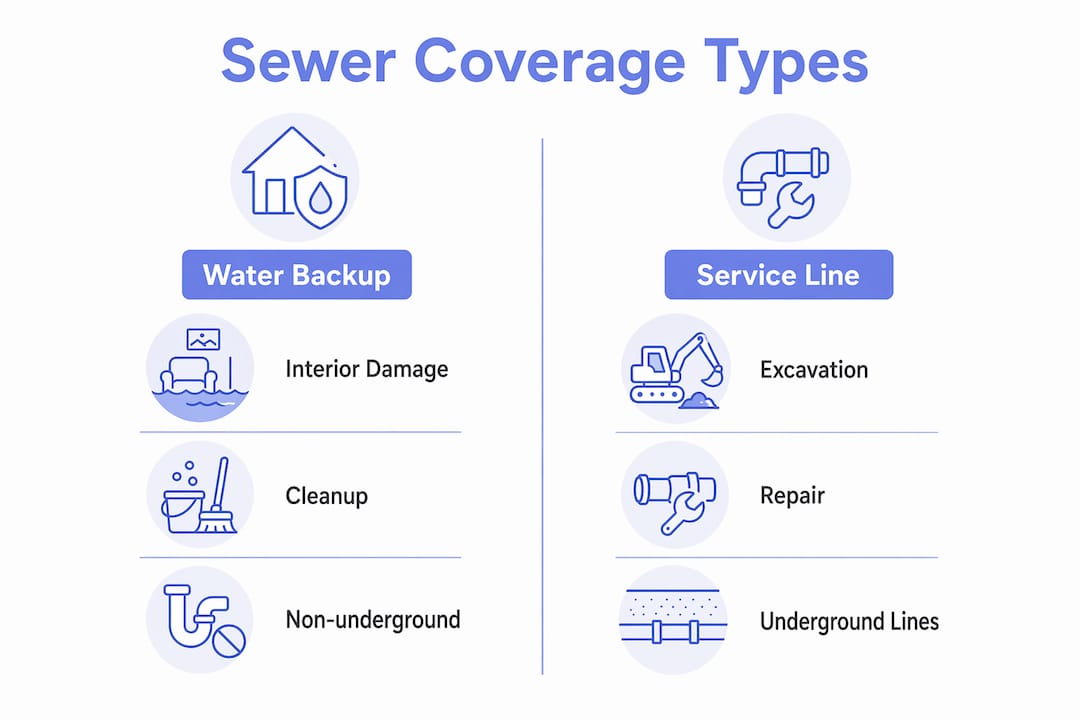
Sewer insurance coverage splits into two distinct products, and most homeowners need both to be fully protected.
Water backup and sump overflow endorsement
The Water Backup and Sump Overflow endorsement covers interior damage caused when sewage or water backs up through drains, toilets, or a failed sump pump. This includes water extraction, structural drying, flooring replacement, drywall repair, and personal property losses inside the home. Coverage limits start at $5,000 and can be increased, though many homeowners underestimate how quickly that baseline disappears. A finished basement with carpet, drywall, and furniture can consume a $5,000 limit on cleanup alone, leaving reconstruction costs entirely out of pocket.
What this endorsement does not cover is equally important. It excludes repair or replacement of the underground sewer lateral pipe connecting your home to the municipal system. It also excludes surface flooding from rising water outside the home.
Service line coverage
Service Line coverage pays for excavation and replacement of the underground sewer lateral when it cracks, collapses, or becomes blocked by root intrusion. Excavation and pipe replacement typically costs $3,000 to $7,000, and that bill falls entirely on the homeowner without this endorsement. Service Line coverage focuses on the buried pipe outside the home’s foundation, not the internal drains or fixtures inside.
Key exclusions across both endorsements include:
- Wear and tear or gradual deterioration of pipes
- Surface flooding from external water sources (covered separately by the National Flood Insurance Program, or NFIP)
- Internal plumbing issues such as leaks under sinks or clogged interior drains
- Damage resulting from the homeowner’s failure to maintain the system
Pro Tip: Ask your agent to show you both endorsements side by side on a quote. Buying only one leaves a coverage gap that could cost you thousands.
Deductibles on these endorsements typically run $250 to $1,000. Choosing a higher deductible lowers the annual premium but increases your out-of-pocket cost at claim time. Match the deductible to what you can realistically pay without financial strain.
How much does sewer insurance coverage cost?
Sewer backup insurance is one of the most affordable endorsements available, which makes the coverage gap even harder to justify. Annual premiums for water backup endorsements run $50 to $250 per year, depending on coverage limits, deductible selection, and property risk factors. Service line coverage costs roughly $5 to $15 per month as a separate add-on.
Several factors push premiums higher for Tennessee homeowners specifically:
- Home age: Older homes in West Tennessee often have clay or cast iron sewer laterals that crack and root-intrude more frequently than modern PVC pipe.
- Finished basements or lower levels: These spaces carry higher restoration costs, which insurers factor into pricing.
- Coverage limit selected: Choosing $25,000 in water backup coverage costs more than the default $5,000 limit but provides meaningfully better protection.
- Deductible: A $250 deductible raises the premium compared to a $1,000 deductible.
- Local infrastructure age: Municipalities in West Tennessee with older sewer mains experience more surcharge events during heavy rain, increasing backup frequency.
The math here is straightforward. Paying $150 per year for a water backup endorsement costs $1,500 over a decade. A single uninsured backup event costs $10,000 or more. Choosing low coverage limits to save on premiums creates substantial financial risk, particularly for homes with finished lower levels that require hazardous cleanup and full reconstruction.
Common misconceptions about home insurance sewer protection
The most damaging misconception is that a standard homeowners policy already covers sewer damage. It does not. Standard homeowners policies exclude sewer and drain backup damage entirely, and the endorsements that provide this protection must be purchased separately and proactively.
A second common confusion involves mixing up water backup coverage with sewer line repair coverage. These are not the same product. Water backup coverage pays for interior damage. Service Line coverage pays for the underground pipe repair. Homeowners need both to avoid a gap where the interior is covered but the broken pipe causing the backup is not, or vice versa.
A homeowner with only water backup coverage files a claim after sewage floods the basement. The insurer pays for cleanup and flooring. Then the homeowner receives a $6,000 excavation bill to replace the collapsed sewer lateral. Without Service Line coverage, that bill is entirely out of pocket. Two endorsements, not one, close this scenario completely.
Claims also get denied more often than homeowners expect. Insurers sometimes classify backup damage as flood damage or as a maintenance issue, both of which fall outside endorsement coverage. Licensed plumber inspections and video evidence of the pipe are the most effective tools for proving sudden failure rather than gradual neglect. Document everything before any cleanup begins.
Many homeowners never verify whether these endorsements appear on their Declarations Page until after a loss. The Declarations Page is the first two to three pages of your insurance packet. If Water Backup or Service Line coverage does not appear there by name, you do not have it.
Pro Tip: Pull out your Declarations Page right now and search for the words “water backup” or “service line.” If you do not see them, call your agent before the next heavy rain season.
How can Tennessee homeowners evaluate their sewer-related risks?
Evaluating your sewer risk starts with your policy, not your pipes. Check the Declarations Page for both the Water Backup endorsement and Service Line coverage. If either is missing, contact your agent to add it before the next storm season. Tennessee’s spring weather brings heavy rainfall that overwhelms municipal sewer systems and pushes sewage back into homes through floor drains and toilets.
Once coverage is confirmed, choose limits that reflect your home’s actual exposure:
- Assess your lower level. A finished basement with flooring, drywall, and furniture requires far more than $5,000 to restore. Choose a limit of $25,000 or higher if your lower level is finished.
- Match Service Line limits to local excavation costs. In West Tennessee, excavation through established landscaping or driveways can push pipe replacement costs above the standard estimate. Ask your agent what limits are available.
- Install a backwater valve. Backwater valve installation costs $300 to $1,500 and physically prevents sewage from flowing back into the home during a municipal surcharge event. Some insurers offer discounts for this installation.
- Add a sump pump battery backup. A battery backup system keeps the sump pump running during power outages, which frequently accompany the same storms that cause sewer surcharges.
- Schedule a sewer camera inspection. A licensed plumber can run a camera through your sewer lateral to identify root intrusion, cracks, or bellied pipe sections before they cause a backup. This inspection typically costs $150 to $300 and gives you documented proof of pipe condition.
Pro Tip: Combine a sewer camera inspection with your annual HVAC service visit. Both are maintenance tasks that protect your home’s systems and support insurance claims if something goes wrong.
Insurance complements but does not replace proactive maintenance. Regular inspections and preventive devices are the best defense against sewer line failure. Coverage pays for the damage after the fact. Maintenance reduces the chance of damage occurring at all.
Key Takeaways
Sewer backup insurance and Service Line coverage are two separate endorsements that together provide complete protection against sewer-related losses, which standard homeowners policies exclude entirely.
| Point | Details |
|---|---|
| Standard policies exclude sewer damage | Add Water Backup and Service Line endorsements proactively; they are not included by default. |
| Two endorsements cover different costs | Water Backup covers interior damage; Service Line covers underground pipe repair and excavation. |
| Coverage limits matter significantly | A $5,000 limit can be consumed by cleanup alone; choose limits that match your home’s actual restoration cost. |
| Verify coverage on Declarations Page | Check the first two to three pages of your policy packet for both endorsements by name. |
| Preventive measures reduce risk and cost | Backwater valves and sump pump battery backups lower claim frequency and may qualify for discounts. |
What I’ve learned after years of watching homeowners get blindsided by sewer claims
The claim I see cause the most financial pain is not a fire or a roof collapse. It is a sewer backup in a finished basement that the homeowner assumed was covered. The assumption is understandable. You pay for homeowners insurance. Sewage backing into your home feels like exactly the kind of disaster insurance exists for. But the exclusion is real, and the financial hit is severe.
What surprises me most is how few homeowners have ever looked at their Declarations Page. That document tells you everything your policy actually covers, and it takes about two minutes to read. If you have never checked it for water backup and service line endorsements, you are carrying a risk you probably do not realize you have.
The other mistake I see regularly is buying the minimum $5,000 water backup limit to keep the premium low. That choice makes sense on paper until you price out what it actually costs to gut and rebuild a finished basement after sewage contamination. Hazardous waste cleanup, flooring, drywall, paint, and furniture replacement add up fast. The premium difference between a $5,000 limit and a $25,000 limit is often less than $50 per year. That is not a trade-off worth making.
My honest advice: buy both endorsements, choose limits that reflect what your home would actually cost to restore, install a backwater valve, and look at your Declarations Page every time your policy renews. Sewer problems are not rare in West Tennessee. They are a predictable risk, and predictable risks deserve real coverage.
— josh
Roman-insurance can help you close the coverage gap
Tennessee homeowners who want to verify or add sewer coverage do not need to sort through policy documents alone. Roman-insurance specializes in homeowners insurance coverage for high-value residential properties in West Tennessee, with a focus on the communities within and around the 38002 zip code. As an Allstate agency, Roman-insurance can add Water Backup and Service Line endorsements directly to your existing policy or build a new policy that includes both from the start.
Checking your current coverage takes one conversation. Roman-insurance reviews your Declarations Page with you, identifies gaps, and recommends limits based on your home’s specific features, including finished lower levels and local infrastructure risk. Homeowners in Germantown and surrounding West Tennessee communities can connect with a local agent for a personalized review and quote.
FAQ
Does standard homeowners insurance cover sewer backup damage?
Standard homeowners insurance does not cover sewer or drain backup damage. Homeowners must purchase a separate Water Backup and Sump Overflow endorsement to receive this protection.
What is the difference between water backup coverage and service line coverage?
Water Backup coverage pays for interior damage and cleanup caused by a backup. Service Line coverage pays for excavation and repair of the underground sewer pipe outside the home. Both are needed for complete protection.
How much does sewer backup insurance cost per year?
Water Backup endorsements typically cost $50 to $250 annually. Service Line coverage runs approximately $5 to $15 per month, making both among the most affordable homeowners insurance add-ons available.
Does sewer backup insurance cover surface flooding?
Sewer backup insurance does not cover damage from surface flooding or rising external water. That risk requires a separate flood insurance policy, typically purchased through the National Flood Insurance Program.
How do I know if I already have sewer coverage on my policy?
Check the Declarations Page at the front of your insurance packet. If “Water Backup” or “Service Line” does not appear there by name, the coverage is not active on your policy.