Earth movement insurance is defined as specialized coverage that protects homeowners from structural and property damage caused by ground shifting events, including landslides, sinkholes, and earthquakes. Standard homeowners policies in Tennessee do not cover these perils. The ISO HO-3 and HO-5 policy forms used by most U.S. insurers explicitly exclude all forms of earth movement, regardless of whether rainfall, gravity, or seismic activity triggers the event. For West Tennessee homeowners, where karst geology creates real sinkhole risk and slope instability is a documented concern, this gap in standard coverage is not theoretical. It is a financial exposure that demands a direct answer.
What is earth movement insurance and what does it cover?
Earth movement insurance is a category of property coverage designed to fill the gap left by standard homeowners policies. The industry term you will hear most often is a Difference in Conditions policy, commonly called a DIC policy. These policies, along with specialized endorsements, are the two primary tools for securing ground movement protection.
The perils covered under earth movement insurance typically include landslides, mudslides, sinkholes, subsidence, and earthquake damage. Subsidence refers to the gradual sinking or settling of the ground beneath a structure. Each of these events can cause severe structural damage, yet none of them triggers a payout under a standard HO-3 or HO-5 policy.
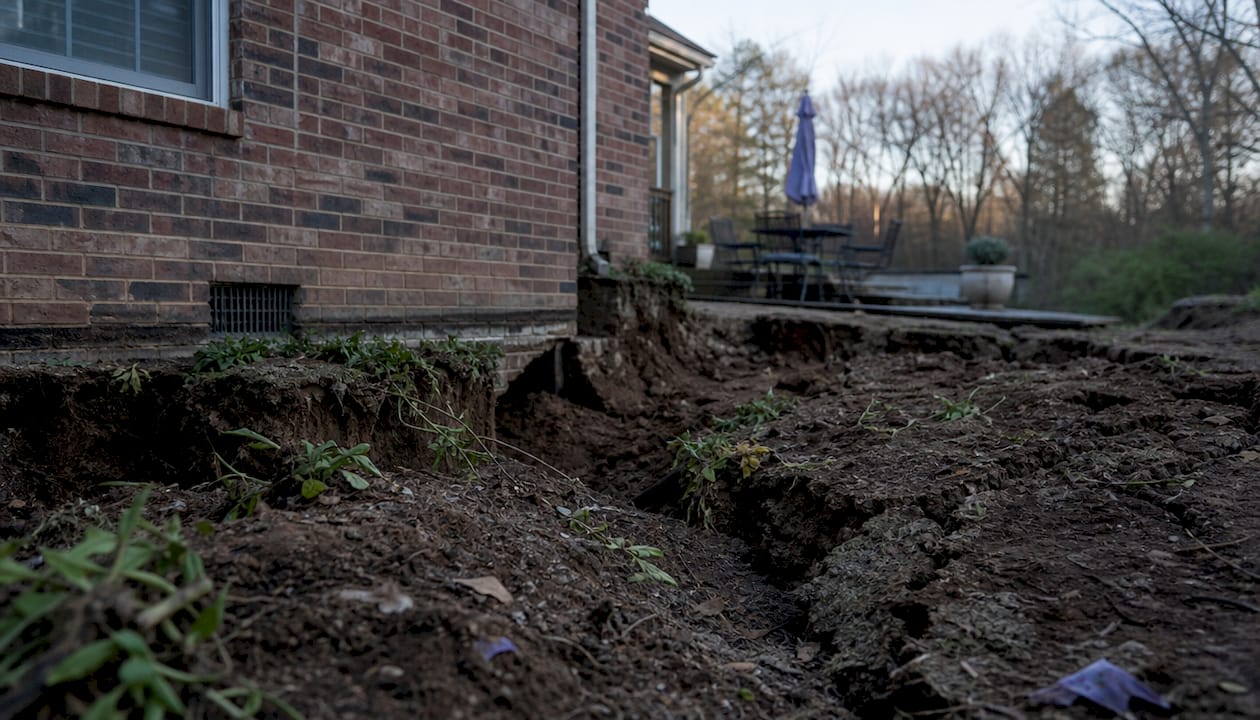
Tennessee sits on geology that makes this coverage relevant. The western part of the state contains areas with loess soils, which are wind-deposited sediments prone to erosion and slope failure after heavy rain. Parts of Middle Tennessee sit above limestone bedrock, which dissolves over time and creates sinkholes. Homeowners near bluffs, slopes, or areas with known karst activity face measurable risk.
Pro Tip: If your property sits on a slope, near a bluff, or in an area with known sinkhole activity, ask your agent specifically about geological hazard coverage before your next renewal date.
How does earth movement insurance differ from earthquake and flood coverage?
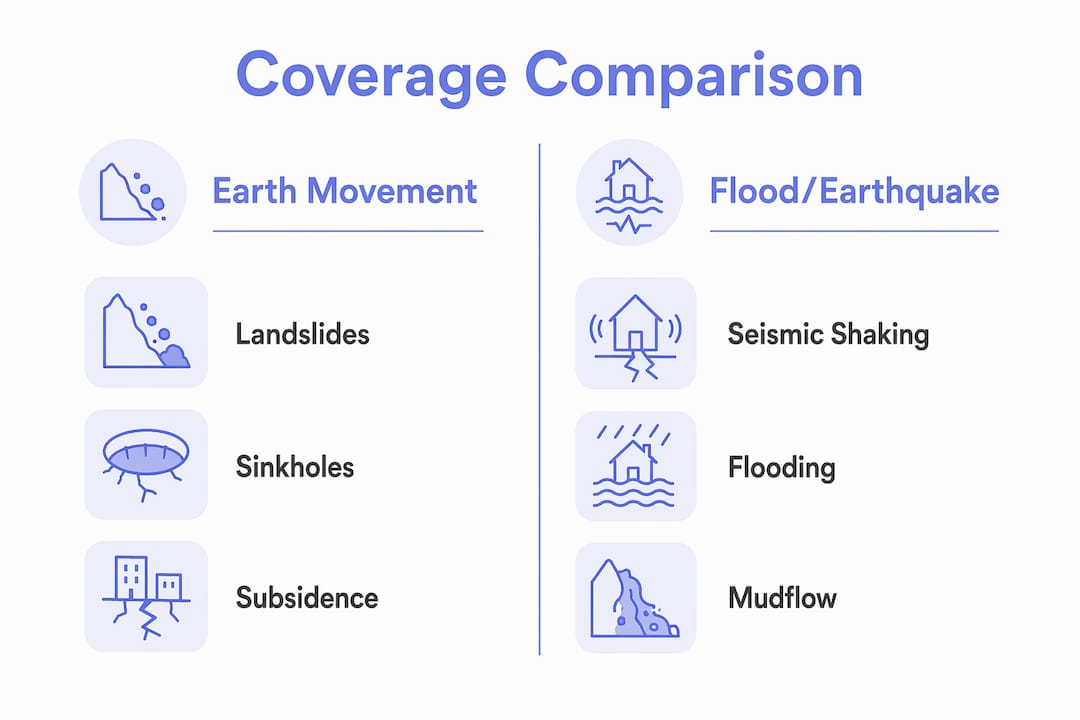
These three coverage types address different perils, and the distinctions matter when a claim occurs.
Earthquake insurance focuses on damage caused by seismic shaking and the structural collapse that follows. It is typically sold as a standalone policy or endorsement and carries high percentage deductibles ranging from 2.5% to 25% of dwelling coverage. That means on a $300,000 home, a homeowner could owe $7,500 to $75,000 out of pocket before coverage applies. Smaller damage events often fall entirely below the deductible threshold, which affects whether earthquake coverage delivers real value for a given property.
Flood insurance, most commonly issued through the National Flood Insurance Program (NFIP), covers water-related damage including mudflow under specific definitions. Mudflow is defined as a river of liquid mud caused by flooding, not by a landslide. A slope failure that sends mud across your yard is a landslide, not a mudflow, and flood insurance will not cover it.
Earth movement insurance covers the broader category of ground displacement events that neither earthquake nor flood policies address. The table below shows how coverage responsibilities divide across a typical loss scenario.
| Loss scenario | Earthquake coverage | Flood/NFIP | Earth movement/DIC |
|---|---|---|---|
| Seismic shaking cracks foundation | Yes | No | Varies by policy |
| Sinkhole swallows driveway | No | No | Yes |
| Slope failure damages retaining wall | No | No | Yes |
| Mudflow from flooding undermines slab | No | Yes (mudflow) | No |
| Subsidence causes settling cracks | No | No | Yes |
Pro Tip: Never assume flood insurance covers landslide damage. The NFIP mudflow definition is narrow. Confirm your DIC policy explicitly lists landslide and slope failure as covered perils.
What coverage options are available to Tennessee homeowners?
Tennessee homeowners have several paths to securing protection against geological hazard coverage gaps.
-
DIC policies. A Difference in Conditions policy wraps around your standard homeowners policy and covers perils the base policy excludes. DIC policies cost between $800 and $5,000 annually depending on location, home value, slope exposure, and soil type. They provide the broadest earth movement protection available in the private market.
-
Earth movement endorsements. Some insurers allow homeowners to add an endorsement directly to their standard policy. Endorsements are generally less expensive than standalone DIC policies but may carry narrower coverage definitions. Always read the endorsement language carefully to confirm which specific perils are listed.
-
Tennessee sinkhole requirements. Tennessee law requires insurers to offer sinkhole coverage, and state law mandates catastrophic ground collapse coverage in standard homeowners policies. Catastrophic ground collapse is a narrower definition than full sinkhole coverage. It typically requires visible structural damage and a confirmed geological event. Homeowners who want broader sinkhole protection beyond the statutory minimum should ask about supplemental sinkhole endorsements.
-
Earthquake endorsements. For homeowners near the New Madrid Seismic Zone, which affects parts of West Tennessee, a standalone earthquake endorsement is worth evaluating. The New Madrid fault system has produced major seismic events historically, and property insurance for earthquakes in this region is available through several admitted carriers.
-
Mine subsidence programs. Mine subsidence coverage applies where underground mining has occurred. Certain counties in Tennessee have historical coal or mineral extraction activity. Homeowners in those areas should ask whether a mine subsidence endorsement or state program applies to their location.
Underwriting factors that affect your premium include proximity to known fault lines or sinkhole zones, slope angle and soil composition, the age and construction type of the home, and prior claims history. A geological survey report can sometimes support a lower premium by documenting stable soil conditions.
How does the earth movement exclusion affect claims?
The earth movement exclusion in standard policies is written broadly. Most policies exclude natural and some human-caused ground shifting, covering events triggered by rainfall, gravity, seismic activity, or even nearby construction vibration. Courts in different states have interpreted the human-caused exclusion differently, but Tennessee homeowners should not count on a favorable ruling.
Two legal clauses make claims particularly difficult under standard policies.
-
Efficient proximate cause. This doctrine asks what the dominant cause of a loss was. If earth movement is the primary cause, the exclusion applies even if a secondary covered peril contributed to the damage.
-
Anti-concurrent causation (ACC) clauses. Many modern policies include ACC language stating that if an excluded peril contributes to a loss in any sequence, the entire claim is denied. This means even if fire breaks out after a landslide damages your gas line, the ACC clause could deny the fire claim if earth movement is listed as a contributing cause.
-
Ensuing loss exceptions. Some policies carve out coverage for losses that result from an excluded peril but are themselves covered perils. Water damage from a burst pipe caused by earth movement may be covered as an ensuing loss. Read the policy language carefully or ask your agent to explain which ensuing losses your policy recognizes.
-
Engineering documentation. An independent engineering report is the most important document in an earth movement claim. It establishes the cause of damage, the extent of structural impact, and the sequence of events. Without it, insurers have wide latitude to deny or reduce a claim.
Pro Tip: If you suspect earth movement damage, hire a licensed geotechnical engineer before contacting your insurer. Their report frames the claim and protects your position.
Filing a claim under a standard policy for an excluded peril carries a specific risk. Denied claims appear in CLUE reports and can raise future premiums or trigger non-renewal. File claims only under the policy that actually covers the peril.
What should Tennessee homeowners consider when choosing coverage?
Choosing the right ground movement protection requires matching coverage to your specific property risk, not buying the cheapest available option.
-
Assess your location first. Properties on slopes, near bluffs, above limestone bedrock, or in flood-prone areas carry higher earth movement risk. A topographic map and a conversation with a local geotechnical engineer can clarify your exposure before you spend money on premiums.
-
Compare endorsements versus DIC policies. An endorsement is cheaper but narrower. A DIC policy costs more but covers a wider range of perils and typically has fewer exclusions. For high-risk properties, the DIC policy is the stronger choice.
-
Understand your deductible. Earthquake endorsements often use percentage deductibles rather than flat amounts. On a $250,000 home with a 10% deductible, you absorb the first $25,000 of any earthquake loss. High deductible percentages mean smaller damage events produce no payout, so weigh that reality against the annual premium cost.
-
Take mitigation steps. Retaining walls, French drains, and improved grading reduce slope failure risk. Some insurers credit these improvements at underwriting. A drainage improvement that costs $3,000 may reduce your annual premium and protect your foundation simultaneously.
-
Review your policy annually. Many homeowners only discover the earth movement exclusion after a catastrophic loss. An annual review with a knowledgeable agent catches coverage gaps before a geological event creates them. Roman-insurance agents serving West Tennessee can walk through your current policy and identify where earth movement exposure exists.
Federal disaster aid after landslides or earthquakes typically arrives as low-interest loans, not grants. Relying on government assistance is a financial gamble that most homeowners cannot afford to take.
Key Takeaways
Earth movement insurance is the only reliable way to protect a Tennessee home from landslide, sinkhole, and subsidence losses that standard homeowners policies explicitly exclude.
| Point | Details |
|---|---|
| Standard policies exclude earth movement | ISO HO-3 and HO-5 forms exclude all ground shifting perils, regardless of cause. |
| DIC policies fill the gap | Difference in Conditions policies cover landslides, sinkholes, and subsidence for $800–$5,000 annually. |
| Tennessee has sinkhole requirements | State law mandates catastrophic ground collapse coverage, but broader sinkhole protection requires a separate endorsement. |
| Deductibles on earthquake coverage are high | Percentage deductibles of 2.5%–25% mean most small earthquake claims produce no payout. |
| Annual policy reviews prevent surprises | Reviewing coverage each year with an agent is the most effective way to close earth movement gaps before a loss occurs. |
Why I think most Tennessee homeowners are underinsured for this specific risk
I have reviewed a lot of homeowners policies in West Tennessee, and the pattern is consistent. Homeowners assume their standard policy covers “natural disasters.” It does not. The earth movement exclusion is one of the broadest exclusions in any property policy, and most people never read it until a claim is denied.
The timing issue is the part that concerns me most. Insurers impose moratoriums on new earth movement coverage immediately after a geological event in an area. If a sinkhole opens on your street, you cannot buy coverage that afternoon. The window closes fast, and it stays closed until the insurer decides the risk has stabilized, often at a higher premium.
The cost argument against buying coverage rarely holds up under scrutiny. A DIC policy on a $250,000 home in a moderate-risk area costs less per month than most car insurance payments. The financial exposure it covers runs into six figures. That math is not complicated.
My honest advice: if your home sits within 10 miles of the Memphis metro area, near any West Tennessee bluff, or on soil you have never had tested, treat earth movement coverage as a non-negotiable line item. The New Madrid Seismic Zone is not a historical footnote. It is an active fault system beneath your property.
— josh
How Roman-insurance helps Tennessee homeowners close coverage gaps
Roman-insurance works with homeowners across West Tennessee, including those within the 38002 zip code area, to identify earth movement exposure and find coverage solutions that fit the property and the budget.

Roman-insurance agents review your current homeowners insurance policy to identify where the earth movement exclusion creates financial risk. From there, the conversation moves to endorsement options, DIC policy quotes, and sinkhole coverage under Tennessee law. Homeowners in the Germantown area can also connect with the Roman-insurance Germantown team for a localized risk review. Getting the right coverage starts with a single conversation, and Roman-insurance makes that conversation straightforward.
FAQ
What does earth movement insurance cover?
Earth movement insurance covers structural and property damage caused by ground shifting events including landslides, sinkholes, mudslides, subsidence, and earthquakes. These perils are excluded from standard ISO HO-3 and HO-5 homeowners policies.
Does Tennessee require any earth movement coverage by law?
Tennessee law requires insurers to include catastrophic ground collapse coverage in standard homeowners policies and to offer sinkhole coverage. Catastrophic ground collapse applies only when visible structural damage and a confirmed geological event occur simultaneously.
How much does a DIC policy cost in Tennessee?
DIC policies typically cost between $800 and $5,000 per year, depending on the home’s location, value, slope exposure, and soil type. Properties near known sinkhole zones or fault lines pay higher premiums.
Will flood insurance cover a landslide on my property?
Flood insurance through the NFIP covers mudflow, which is defined as a river of liquid mud caused by flooding. A slope failure or landslide does not meet that definition and is not covered under standard flood policies.
Can filing a denied earth movement claim hurt my insurance record?
Yes. Denied claims for excluded perils appear in CLUE reports and can raise future premiums or lead to non-renewal. Homeowners should file claims only under the policy that covers the specific peril causing the damage.