Tennessee does not require gap insurance by law, but your lender or lessor may require a GAP waiver as a condition of your financing. Under Tennessee Code § 56-59-103, no creditor can force you to buy a GAP waiver to get a loan or lease approved. That said, if you financed a vehicle with less than 20% down, rolled negative equity into the loan, or signed a lease, you likely need this coverage. The state average runs at a moderate annual cost when added as an endorsement to an auto policy. Your first move: pull out your loan or lease agreement, check whether a GAP waiver is listed as required, and contact Roman-insurance for a local quote before you accept whatever the dealer quoted you.
Pro Tip: Read your finance contract before you leave the dealership. The GAP waiver disclosure must be in writing under Tennessee law — if it isn’t, you have grounds to cancel.
Table of Contents
- How much does gap insurance cost in Tennessee?
- What gap insurance actually covers and how a claim pays out
- Tennessee law, lender requirements, and your consumer rights
- Do you actually need GAP coverage as a Tennessee driver?
- Where to buy GAP in Tennessee and what each channel costs you
- Questions to ask when comparing GAP options in Tennessee
- How to file a GAP claim in Tennessee and what to watch for
- How the cost figures in this guide were calculated
- Key Takeaways
- A Tennessee agent’s perspective on GAP: what locals often get wrong
- Roman-insurance can help you compare and buy GAP coverage in West Tennessee
- Official sources and further reading
How much does gap insurance cost in Tennessee?
Tennessee gap coverage averages $1,752 per year, or about $146 per month, when bundled as an endorsement on a standard auto policy. That figure covers the gap premium itself, not your full auto insurance bill. Rates shift based on your carrier, city, vehicle age, and loan balance.
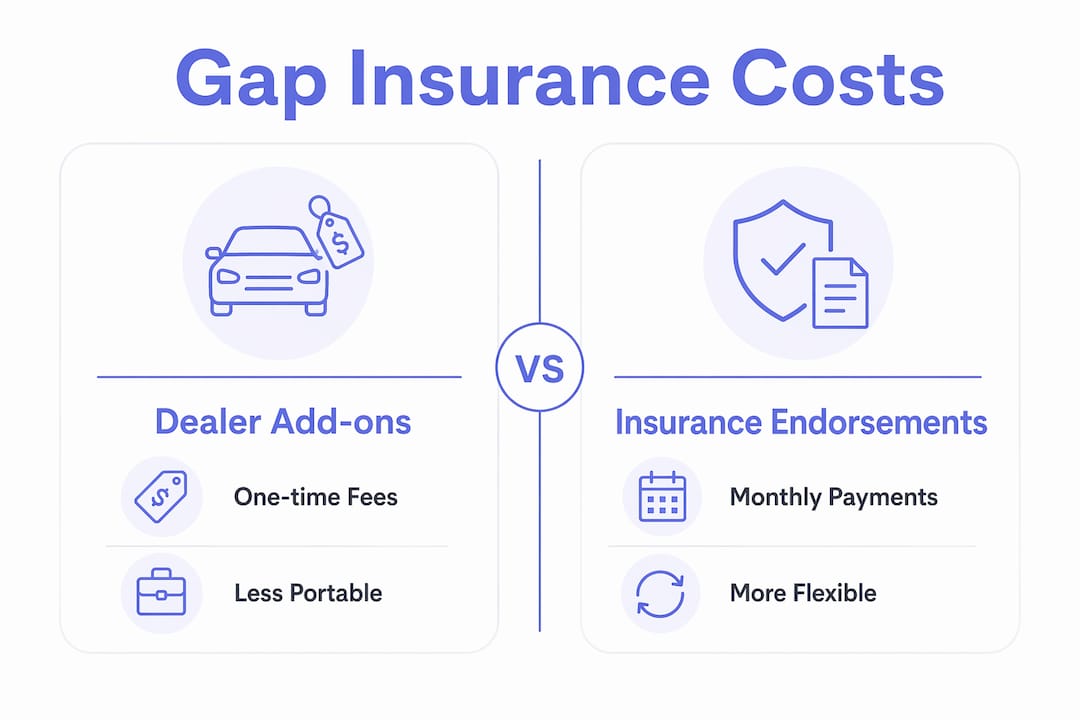
The pricing format matters as much as the number. Dealer and lender add-ons are typically a one-time fee rolled into your loan, often several hundred dollars. An insurer endorsement, by contrast, can run as little as $2–$8 per month with some carriers. That difference sounds small until you do the math over a 72-month loan.
Worked example: Say you finance a $35,000 truck. A dealer charges a one-time GAP fee of $800, which gets rolled into your loan at 7% interest. Over 72 months, you pay closer to $1,100 for that coverage. An insurer endorsement at $8/month costs $576 over the same term, with no interest, and you can cancel it the moment your loan balance drops below the truck’s value.
| Coverage metric | Figure |
|---|---|
| Tennessee state average (annual) | $1,752 |
| Tennessee state average (monthly) | $146 |
| Insurer endorsement low end | $2–$8/month |
| Lowest city average (Bristol, TN) has a relatively low annual cost. | |
| Average Tennessee auto loan balance is moderate for the region. |
City-level data shows some cities at the low end of the state with lower annual costs, while higher-crime urban areas push rates up. West Tennessee cities like Memphis tend to land above the statewide average because theft and accident rates are higher there.
What gap insurance actually covers and how a claim pays out
GAP insurance fills the dollar gap between what your collision or comprehensive insurer pays (the actual cash value, or ACV) and what you still owe on your loan or lease after a total loss or theft.

Here’s a concrete example. Your car is totaled. Your primary insurer values it at $22,000 and cuts you a check for $21,500 after your $500 deductible. Your loan payoff is $27,000. Without GAP, you owe $5,500 out of pocket on a car you no longer have. With GAP, the waiver or policy covers that $5,500 balance. Note: GAP does not cover your deductible in most cases. That $500 is still yours to pay.
What GAP typically includes:
- The difference between ACV payout and remaining loan or lease balance
- Negative equity that was rolled into the current loan (subject to policy limits, often capped at a percentage above ACV)
- Lease termination balances after a total loss
Common exclusions to watch for:
- Your primary policy deductible (usually not covered)
- Prior loan balances from a previous vehicle not related to this one
- Overdue payments or late fees on the loan
- Modifications or aftermarket equipment that inflated the vehicle’s purchase price
- Losses not covered by your primary policy (e.g., mechanical breakdown)
Pro Tip: GAP is most valuable in the first 24–36 months of a long-term loan, when depreciation is steepest and your loan balance is still well above the car’s market value. Industry experts recommend it specifically when your down payment was under 20% or your loan term exceeds 60 months.
Tennessee law, lender requirements, and your consumer rights
Tennessee permits GAP waivers under the Guaranteed Asset Protection Waiver Act, but the statute puts real teeth behind consumer protections. The core rule: a creditor cannot condition your loan or lease approval on buying a GAP waiver. If a dealer tells you that you must take their GAP product to get financed, that violates Tennessee Code § 56-59-103.
That 90-day window is the detail most Tennessee drivers miss. If you pay off your loan early or refinance, you have 90 days to submit a written cancellation request and claim your prorated refund. Miss that window and you may forfeit money you’re owed.
Your practical consumer-rights checklist:
- Locate the GAP waiver disclosure in your finance contract (it must be a separate written document)
- Confirm it lists: purchase price, refund method, administrator name and contact, and cancellation procedure
- Submit cancellation in writing to the creditor or administrator, not just verbally
- Keep a copy of your written cancellation request and note the date sent
- Follow up if you haven’t received a refund confirmation within 45 days
- If you refinance, notify both the old and new lender about your existing GAP waiver status
Under Tennessee Code § 56-59-103, GAP waivers may be sold as a single payment or periodic payments, and creditors must handle the funds in a fiduciary capacity. That means the dealer or lender is legally obligated to forward your GAP premium to the insurer or administrator — it’s not discretionary.
Do you actually need GAP coverage as a Tennessee driver?
Most Tennessee drivers who financed a vehicle in the last two years should at least run the numbers, considering typical loan balances and vehicle depreciation. That math alone creates a gap for most financed buyers.
You likely need GAP if:
- Your down payment was less than 20% of the vehicle’s purchase price
- Your loan term is 60 months or longer
- You rolled negative equity from a previous vehicle into this loan
- You’re leasing (most lease agreements require a GAP waiver)
- You bought a vehicle that depreciates quickly (luxury SUVs, certain trucks, electric vehicles)
- You live in a higher-theft area like Memphis or Nashville
You probably don’t need GAP if:
- You put 20% or more down and the loan balance is already close to the car’s market value
- You’re more than halfway through a short-term loan (48 months or less)
- You own the vehicle outright
- You bought a used vehicle with a low remaining loan balance
A quick borderline case: a Germantown buyer finances a new $42,000 SUV for 72 months with 10% down. In month one, they owe roughly $38,000 while the car is worth maybe $34,000. GAP makes clear sense there. Contrast that with someone who buys a three-year-old used sedan for $14,000, puts $4,000 down, and takes a 36-month loan. The depreciation curve is already flatter, and they may be above water within 12 months. GAP is a much weaker case.
Where to buy GAP in Tennessee and what each channel costs you
There are four main ways to get Tennessee gap coverage, and the price differences between them are significant enough to matter.
| Channel | Typical cost format | Portability | Cancellation/refund |
|---|---|---|---|
| Dealer add-on waiver | One-time fee, rolled into loan | Stays with original loan | Refund per Tennessee statute; written request required |
| Lender-administered waiver | Single or periodic payment | Tied to that lender | Same statutory rules apply |
| Insurer endorsement | Monthly/annual premium | Transfers when you switch policies | Cancel anytime; prorated refund |
| Standalone third-party policy | Monthly/annual premium | Portable | Cancel anytime; prorated refund |

The dealer add-on is the most common and usually the most expensive option per dollar of coverage. Consumer guides consistently recommend comparing a third-party insurer endorsement to whatever the dealer quotes, because insurer endorsements are frequently less expensive over the life of the loan.
A few things worth knowing about how dealer waivers are funded: under Tennessee law, the creditor or retail seller may insure the waiver obligation through a contractual liability policy or use an administrator. That means the entity you signed with at the dealership may not be the one who actually pays your GAP claim. Get the administrator’s name and contact information in writing before you leave the lot.
Before you commit to any channel, confirm:
- Whether the waiver is insured or self-funded by the dealer
- The exact refund methodology if you cancel or pay off early
- Whether the coverage transfers if you refinance with a different lender
- The total cost in dollars over your full loan term, not just the monthly add-on
Questions to ask when comparing GAP options in Tennessee
The single most important question to ask any dealer, lender, or insurance agent: “How is my refund calculated if I cancel early or pay off the loan ahead of schedule?” The answer tells you immediately whether the product is worth its price.
Full question script to use:
- What is the total cost of this GAP product in dollars over my loan term?
- Is this waiver insured by a licensed insurer, or is it self-funded?
- Who is the administrator, and how do I contact them directly?
- What is the exact refund methodology if I cancel or refinance?
- Is the waiver transferable if I refinance with a different lender?
- Does the cost of this waiver affect my total finance charge?
- What written disclosure will I receive, and when?
- Are there any exclusions for modifications or aftermarket equipment on my vehicle?
Red flags that should make you pause:
- No written disclosure offered before signing
- Fees described as “non-refundable” after the free-look period with no explanation
- Refusal to name the insurer or administrator backing the waiver
- Vague answers about refund methodology (“we’ll figure it out if it comes to that”)
- GAP presented as required to get your loan approved
To compare a dealer’s one-time fee to an insurer’s monthly endorsement, divide the dealer fee by your loan term in months. A $700 dealer fee on a 60-month loan is roughly $11.67/month. If an insurer endorsement runs $6/month, you save about $340 over the loan term, plus you avoid paying interest on the rolled-in fee.
How to file a GAP claim in Tennessee and what to watch for
After a total loss, GAP pays what’s left after your primary insurer settles. The process is sequential, not simultaneous.
Step-by-step claim process:
- Notify your primary auto insurer immediately and open a total-loss claim
- Cooperate with the ACV appraisal; request the written valuation report
- Obtain your official loan payoff statement from your lender (get the 10-day payoff figure)
- Contact your GAP waiver administrator or insurer with the ACV payout amount and loan payoff figure
- Submit all required documents: ACV settlement letter, loan payoff statement, police report if theft, and your GAP disclosure agreement
- Keep copies of everything; note the date of each submission
Common exclusions and limits to know before you file:
- Your primary policy deductible is not covered by most GAP products
- Overdue loan payments at the time of the loss may be excluded
- Prior loan balances rolled in from a previous vehicle may be capped or excluded
- Aftermarket modifications that inflated the original purchase price are often not counted
- Claims must typically be filed within a specific window after the primary insurer settles
Documents to keep accessible (phone photos work):
- Your original GAP waiver or policy disclosure
- The GAP administrator’s name and direct contact number
- Your loan agreement showing original balance and term
- Your primary auto insurer’s contact and policy number
Thinking through your deductible strategy before a loss matters here. A higher deductible lowers your monthly premium but leaves a larger out-of-pocket gap that your GAP waiver won’t fill.
How the cost figures in this guide were calculated
The cost averages cited throughout this article come from two primary sources: Insure.com’s Tennessee-specific gap insurance rate data and insurance.com’s Tennessee gap insurance analysis. Both aggregate actual insurer rate data across Tennessee ZIP codes and carriers. The Tennessee statute citations come directly from the Justia database of Tennessee Code, Title 56, Chapter 59.
| Source | What it was used for |
|---|---|
| Insure.com (Tennessee gap data) | State average annual/monthly cost; city-level breakdowns |
| insurance.com (Tennessee gap analysis) | Cross-check on state average; age-group rate data |
| Tennessee Code § 56-59-103 and § 56-59-105 | Legal rules, consumer rights, disclosure requirements |
| PlanForFreedom (Tennessee guide) | Average loan balance figure; channel comparison context |
| Tricor Insurance (industry PDF) | Monthly endorsement cost range ($2–$8/month) |
Cost figures reflect endorsement-based gap premiums added to a standard auto policy. Standalone dealer waivers and lender-administered products are priced differently and were not included in the averages. Individual quotes will vary based on vehicle make and model, loan balance, down payment amount, driver age, and city. West Tennessee drivers, particularly in the Memphis metro, should expect rates at or above the state average given higher theft and accident frequency in that market.
Key Takeaways
Gap insurance in Tennessee is not legally required, but most financed or leased vehicles benefit from it when the loan balance exceeds the car’s market value, especially in the first two to three years of a long-term loan.
| Point | Details |
|---|---|
| Not required by law | Tennessee statute forbids lenders from conditioning credit approval on buying a GAP waiver. |
| State average cost | Tennessee gap coverage averages $1,752 per year or $146 per month; insurer endorsements can run as low as $2–$8/month. |
| 90-day refund window | Submit a written cancellation request within 90 days of early loan termination to claim your prorated refund. |
| Best candidates | Drivers with under 20% down, loans of 60+ months, or rolled negative equity benefit most from GAP coverage. |
| Roman-insurance | Roman-insurance can review your loan documents, compare dealer vs. insurer GAP costs, and quote a local Allstate-backed option for West Tennessee drivers. |
A Tennessee agent’s perspective on GAP: what locals often get wrong
The most common mistake I see West Tennessee drivers make is accepting the dealer’s GAP waiver without ever asking what it costs over the full loan term. A buyer in Germantown recently came to us after financing a $48,000 SUV. The dealer had rolled a $950 GAP fee into a 72-month loan at 8% interest. By the time we ran the numbers, that coverage was costing them over $1,400 in total. We quoted an Allstate endorsement at under $7/month. Same coverage, roughly half the cost.
The second mistake is forgetting about the 90-day refund window. A Memphis customer refinanced their truck to get a lower rate and never thought to cancel the original GAP waiver. They left a prorated refund on the table simply because no one told them the clock was ticking.
My practical advice for any West Tennessee driver: store a photo of your GAP disclosure in your phone right now, before you need it. After a total loss, you’ll be dealing with your primary insurer, your lender, and the GAP administrator simultaneously. Having that document number and administrator contact on your phone saves real time. And if your vehicle gets totaled, call your primary insurer first, then call us. We can help you navigate the GAP claim process and make sure nothing falls through the cracks.
Roman-insurance can help you compare and buy GAP coverage in West Tennessee
Buying GAP coverage through a local agent gives you something the dealer’s finance office doesn’t: someone who works for you, not the lender. Roman-insurance reviews your loan or lease documents, runs a side-by-side cost comparison between the dealer’s waiver and an insurer endorsement, and can quote you an Allstate-backed option the same day. For most West Tennessee drivers near the 38002 area, that comparison alone saves money.
Three concrete advantages of working with Roman-insurance on your GAP coverage:
- Local policy servicing. If you have a claim or need to cancel, you call a local agent who knows your file, not a national call center.
- Bundling savings. Adding a GAP endorsement to an existing full coverage auto policy through Roman-insurance often costs less than a standalone product, and bundling with home or renters coverage can reduce your overall premium further.
- Paperwork help. If you’re switching from a dealer waiver and need to submit a written cancellation to recover a refund, Roman-insurance walks you through the process.
Get a quote or schedule a policy review at the Roman-insurance Germantown office or visit the auto insurance page to start a comparison online.
Official sources and further reading
The facts in this guide are drawn from primary legal sources and market-rate data. If you need to verify a legal detail or check current rates, go directly to these:
- Tennessee Code § 56-59-103 — The core GAP waiver statute: what waivers may cover, payment options, fiduciary rules, and the prohibition on conditioning credit. Use this if you need the exact statutory language for a dispute.
- Tennessee Code § 56-59-105 — Required disclosure elements, free-look period, cancellation procedure, and the 90-day written-request rule for refunds. This is the document that defines your consumer rights.
- Insure.com Tennessee gap cost data — Source for the $1,752 state average and city-level rate breakdowns used in the cost section.
- PlanForFreedom Tennessee GAP guide — Background on purchase channels and the average Tennessee loan balance figure.
This article is general information for Tennessee vehicle owners and does not constitute legal or financial advice. For questions specific to your loan, lease, or coverage situation, consult your finance agreement, the Tennessee Department of Commerce and Insurance, or a licensed insurance professional.