For West Tennessee homeowners who want agent-backed bundling, Roman Insurance (Allstate-backed local agency) is the recommended starting point. Beyond that, the strongest bundle options fall into four categories: national full-stack carriers for wide availability, member-only military carriers for eligible households, regional mutual insurers for high-value homes with complex coverage needs, and direct-to-consumer digital carriers for price-sensitive shoppers comfortable going online.
Quick shortlist:
- Roman Insurance (Allstate-backed) — Best for West Tennessee homeowners, especially high-value residences; local agent handles endorsements and claims coordination. Available within the Memphis metro and surrounding area.
- National full-stack carriers (State Farm, Nationwide, Travelers, Farmers Insurance) — Best for buyers who want a single-company solution with broad state availability; bundling discounts range from 6% to 23% depending on the carrier.
- Member-only military carriers (USAA) — Best for active military, veterans, and their families; eligibility required, available in all 50 states.
- Regional mutual insurers and independent-agent carriers (Auto-Owners) — Best for owners with high-value homes or unique coverage needs in specific states; strong on replacement-cost endorsements.
- Direct-to-consumer digital carriers (Progressive, Allstate direct) — Best for price-sensitive shoppers who prefer managing everything online; speed and convenience trade off against depth of local support.
- Specialty split-strategy — Best when one carrier’s base rate is inflated; place auto and home with separate specialists and compare the all-in cost.
| Option | Best for | Typical bundle discount | Availability |
|---|---|---|---|
| Roman Insurance | West TN homeowners, high-value homes | Allstate multi-policy rates | West Tennessee / Memphis area |
| National full-stack carriers | Wide-state buyers, single-company preference | 6%–23% | Most U.S. states |
| Member-only military carriers | Military families, veterans | Up to 10% | All 50 states (eligibility required) |
| Regional mutual / agent carriers | High-value homes, complex endorsements | Varies by carrier | Select states |
| Direct-to-consumer digital carriers | Online-first, budget shoppers | 10%–20% | Varies |
| Specialty split-strategy | Households with inflated base rates | Potentially lower all-in cost | Any state |
Table of Contents
- What are the best home and auto insurance bundle options?
- How do you pick the best home and auto bundle for your situation?
- How were these picks evaluated?
- What does the research actually say about bundle savings?
- What should you do next? A final recommendation
- Key Takeaways
- Why local agents still win for high-value homes
- Get a bundled quote from Roman Insurance in West Tennessee
- Useful sources
What are the best home and auto insurance bundle options?
Roman Insurance (Allstate-backed local agency)

Roman Insurance sells Allstate homeowners and auto policies to residential customers in West Tennessee, with a focus on properties within 10 miles of zip code 38002. The agency’s core advantage is not the Allstate product itself — it’s the local agent layer on top of it. For high-value homes, that means someone who can identify whether your dwelling limit reflects actual replacement cost, flag scheduled personal property needs, and coordinate claims without your having to navigate a 1-800 number alone.

Allstate’s bundle home and auto platform supports online quoting, but Roman Insurance adds the agent review that catches gaps a self-serve quote can miss. If you own a high-value home in the Memphis metro, that review is worth the conversation.
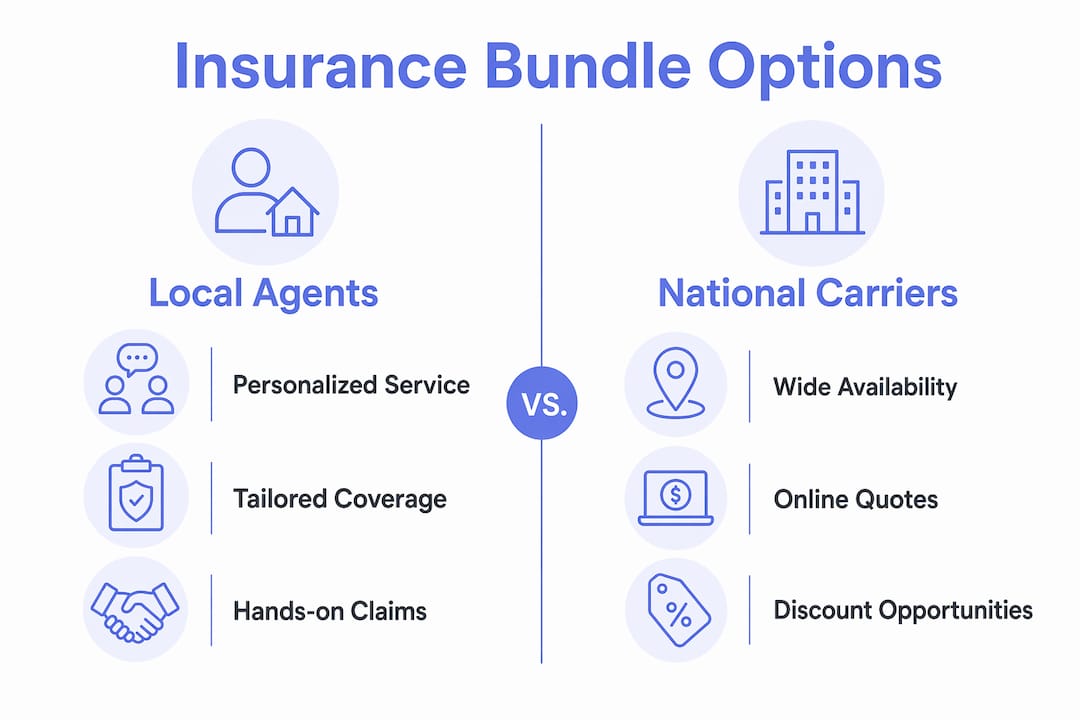
Strengths: Local agent guidance, Allstate product breadth, hands-on claims support, tailored endorsement placement.
Limitations: Service area is West Tennessee; not the right fit for buyers outside the region.
National full-stack carriers
State Farm, Nationwide, Travelers, and Farmers Insurance are the names that dominate national bundle comparisons, and for good reason: they sell both home and auto in most states, offer a single billing relationship, and advertise meaningful multi-policy discounts.
- State Farm — Frequently cited for the largest average bundling discount among major carriers; strong claims satisfaction scores and agent network.
- Nationwide — Available in most states (not Alaska, Louisiana, or Massachusetts for auto); up to 15% bundle discount advertised.
- Travelers Insurance — Solid for homeowners with higher-value properties; offers replacement-cost options and a range of endorsements.
- Farmers Insurance — Offers up to 10% on each policy when bundled; available in most states except a handful including Alaska and Hawaii; 23 auto discounts available.
Strengths: Wide availability, single-company simplicity, established claims infrastructure.
Limitations: Base rates vary significantly by state; the headline discount doesn’t always translate to the lowest all-in cost.
Pro Tip: When getting quotes from national carriers, ask for the combined annual premium — not just the discount percentage. A 20% discount on a high base rate can still cost more than a 10% discount on a lower base rate.
Member-only military carriers
USAA is the benchmark here. It’s available in all 50 states and Washington D.C., but only to active military members, veterans, and their immediate families. For eligible households, USAA offers up to 10% off when bundling home and auto, plus specialized coverages: uniform replacement, discounts for vehicles stored on base, and a waived home insurance deductible for property damaged in combat. No other carrier on this list matches that combination for military families.
Strengths: Competitive pricing for eligible members, specialized military coverages, strong customer satisfaction.
Limitations: Eligibility is non-negotiable; if you don’t qualify, USAA is simply not an option.
Regional mutual insurers and independent-agent carriers
Auto-Owners Insurance is the strongest example in this category. It operates through independent agents, not direct-to-consumer channels, which means placement decisions are made by someone who knows the local market. For high-value homes, that matters: guaranteed replacement cost endorsements, higher liability limits, and scheduled personal property coverage are more reliably placed through an agent than through a self-serve platform.
Strengths: Agent-driven placement, strong endorsement flexibility, often competitive on replacement-cost coverage.
Limitations: Not available in all states; requires working through an independent agent to access.
Direct-to-consumer digital carriers
Progressive and Allstate’s direct platform both offer online bundling. Progressive is particularly strong for auto and allows home bundling through partner carriers. The appeal is speed: quotes in minutes, policy management via app, and straightforward billing.
Adding renters insurance to an auto policy through a digital carrier is one of the clearest bundle wins available — the renters premium is modest, and the auto-side discount can exceed the added cost, per CarSavr’s multi-carrier analysis.
Strengths: Fast quoting, app-based management, accessible for renters and first-time buyers.
Limitations: Less support for complex endorsements; claims coordination is typically self-service.
Specialty split-strategy
This is a strategy, not a carrier. In high-CAT states or for households with a recent auto surcharge, splitting home and auto between two specialized carriers can produce a lower all-in annual cost than any single-bundle option. The trade-off is managing two billing relationships and two claims channels. It’s worth running the numbers, especially if you live in a coastal or storm-prone area where home carriers are thin.
Partial bundling — adding an umbrella policy, a second property’s renters coverage, or motorcycle/ATV coverage — can also unlock multi-policy discounts without forcing a full home-plus-auto consolidation at a single carrier.
Strengths: Can be cheapest for certain households; maximizes each policy’s competitiveness.
Limitations: Two policies, two renewals, two claims processes.
| Option | Best for | Typical discount | Availability | Ease of bundling |
|---|---|---|---|---|
| Roman Insurance | West TN / high-value homes | Allstate multi-policy | West Tennessee | Agent-assisted |
| National full-stack carriers | Single-company, broad availability | 6%–23% | Most states | Agent or online |
| Member-only military carriers | Military families, veterans | Up to 10% | All 50 states (eligibility) | Online + agent |
| Regional mutual / agent carriers | High-value, complex needs | Varies | Select states | Agent only |
| Direct-to-consumer digital | Online-first, budget shoppers | 10%–20% | Varies | Online self-service |
| Specialty split-strategy | Inflated base-rate households | Potentially lowest all-in | Any state | Two separate policies |
How do you pick the best home and auto bundle for your situation?
The single most important rule: prioritize the lowest all-in annual cost with adequate coverage, not the highest advertised discount percentage. A carrier offering 20% off a high base rate can still cost you more than a carrier offering 10% off a lower one.
Decision checklist
Work through these before requesting quotes:
- Ownership status — Are you a homeowner or renter? Renters bundling auto and renters insurance often see strong net savings because the renters premium is low while the auto credit can be meaningful.
- Coverage level on auto — Full-coverage auto policies benefit more from bundling than liability-only. If you carry full coverage in Tennessee, confirm the bundle credit applies to the full premium.
- Home replacement cost — Does your dwelling limit reflect actual rebuild cost, not market value? High-value homes often need guaranteed replacement cost endorsements that not every carrier offers cleanly online.
- Driving record — A recent surcharge can inflate your auto base rate enough to erase bundle savings at some carriers. Run the split-policy comparison if this applies.
- CAT exposure — In storm-prone areas, home carrier availability thins out. Your best home carrier and best auto carrier may not be the same company.
- State-market quirks — Some carriers restrict home coverage in specific states (Nationwide excludes Florida and Hawaii for home; Farmers excludes Alaska and Hawaii). Confirm availability before comparing.
Quotes to run
- Request all-in annual quotes from at least two carriers: one bundle quote and one set of separate quotes from the strongest auto and home specialists in your state.
- Include all endorsements you need (replacement cost, scheduled personal property, umbrella) in every quote so you’re comparing equivalent coverage.
- Calculate the effective discount: (combined separate premiums minus bundle premium) divided by combined separate premiums. That’s the real percentage, not the advertised one.
- Ask about billing: does bundling consolidate to one payment, one renewal date, and one deductible event if a single incident affects both home and auto?
- Note any loyalty or new-customer discounts that expire after year one — they can distort the first-year comparison.
Questions to ask an agent or carrier
- “What is the combined annual premium for both policies, including all endorsements?”
- “Does the bundle discount apply to both policies or only one?”
- “If I file a claim that involves both my home and my car, do I pay one deductible or two?”
- “What happens to my home rate if I move my auto to a different carrier at renewal?”
- “Are there any surcharges or credits that will change after the first year?”
Pro Tip: Re-shop your bundle every 12–18 months. Base rates and discount structures change, and staying with the same carrier out of habit is one of the most reliable ways to overpay. Set a calendar reminder 60 days before each renewal.
How were these picks evaluated?
The shortlist was built on one primary metric: lowest all-in annual cost for adequate coverage, weighted alongside service quality and availability. A carrier with a large advertised discount that still produces a higher combined premium than a competitor did not make the top tier.
Evaluation axes used:
- Multi-policy discount magnitude (advertised ceiling vs. measured average)
- All-in pricing samples across representative policy archetypes (homeowner with full-coverage auto, renter with liability-only auto, high-value home with scheduled personal property)
- Customer service and claims satisfaction signals (complaint ratios, satisfaction data from industry sources)
- Coverage features: guaranteed replacement cost availability, liability limit options, optional endorsements
- State availability and eligibility restrictions
- Agent-supported vs. direct-online service model
Sampling approach: Quote pairs were evaluated for a standard homeowner profile and a high-value home profile, with state-aware adjustments for Tennessee market conditions. Endorsements were held constant across quotes to ensure comparability.
Disclosure: Roman Insurance is the publisher of this article and appears as the recommended local option. Roman Insurance earns commissions from Allstate policies it places. The evaluation criteria and category rankings reflect independent research; Roman Insurance’s placement reflects its genuine fit for the West Tennessee audience this article serves, not paid positioning.
Replication note: To run a similar check yourself, request all-in annual quotes (not monthly) from at least two carriers, include guaranteed replacement cost on the home side and your actual coverage limits on the auto side, and calculate the effective discount on the combined premium rather than accepting the advertised percentage at face value.
What does the research actually say about bundle savings?
Bundling home and auto often saves money, but the gap between advertised and realized savings is real and worth understanding before you commit.
CarSavr’s multi-carrier analysis documented measurable average savings across top U.S. carriers, but also found wide variance: the outcome for any individual household depends heavily on base rates, coverage mix, and state market conditions. The “save up to X%” language carriers use in marketing reflects the ceiling, not the typical result.
What the data shows: Bundling discounts across major carriers range from 6% to 23%, per Forbes Advisor’s analysis of carrier data. The average realized savings sits well below the advertised ceiling for most households — which is exactly why comparing all-in annual cost matters more than the headline percentage.
A few specific dynamics worth knowing:
- Renters plus auto is one of the clearest bundle wins. The renters premium is typically modest, and the auto-side discount can exceed the added cost, making the net result positive even when the home discount alone looks small.
- High-CAT states can flip the math. When home carrier options are thin due to storm exposure, the carrier offering the best home rate may not offer competitive auto rates, and the bundle discount won’t close that gap.
- Recent auto surcharges inflate your base rate at the bundling carrier. If you’ve had a claim or violation in the past three years, run the split-policy comparison before assuming a bundle wins.
- Partial bundling — adding an umbrella, a second property’s renters policy, or motorcycle/ATV coverage — can unlock multi-policy discounts without forcing a full consolidation at a single carrier.
Pro Tip: When you see “save up to 25%,” mentally replace it with “I need to verify what my all-in premium actually is.” The advertised ceiling applies to a specific profile that may not be yours. Run the numbers with your actual coverage levels before deciding.
The administrative benefits of bundling are a separate, often underweighted argument: consolidated billing, a single claims portal, and fewer missed payments are real conveniences, especially for households managing multiple properties or vehicles. When the price difference between bundling and splitting is marginal, those operational benefits often tip the decision.
What should you do next? A final recommendation
If you’re in West Tennessee and own a home, especially a higher-value one, the clearest next step is a conversation with Roman Insurance. The Allstate product suite covers homeowners, auto, umbrella, and life, and the local agent layer means someone is reviewing your coverage for gaps, not just processing a transaction.
For everyone else: run the all-in quote checklist, re-shop every 12–18 months, and don’t let a high advertised discount substitute for actual math on your combined premium.
Five steps to take right now
- Gather your current policy information — dwelling limit, auto coverage levels, deductibles, and any endorsements you currently carry.
- Request all-in annual quotes from at least two options: a bundle quote from your top carrier candidate and separate quotes from the strongest auto and home specialists in your state.
- Compare endorsement coverage, not just base premiums — guaranteed replacement cost, scheduled personal property, and umbrella limits must be equivalent across every quote.
- Ask the sample questions from the decision checklist above, particularly about deductible behavior when a single event affects both home and auto.
- Decide and set a renewal reminder — 60 days before your next renewal date, re-run the comparison. Rates change; your best option today may not be your best option in 18 months.
Timeline note: From quote request to policy activation, most carriers complete the process in 1–5 business days for standard profiles. High-value homes may require an inspection or additional underwriting, which can extend the timeline by one to two weeks. Keep your current policies active until the new ones are confirmed in writing.
Key Takeaways
Bundling home and auto insurance usually saves money, but the all-in annual premium is the only number that tells you whether a specific bundle actually beats the alternative.
| Point | Details |
|---|---|
| Compare all-in cost, not discount % | A 20% discount on a high base rate can cost more than a 10% discount on a lower one. |
| Bundling discounts vary significantly; realized savings often fall below the advertised ceiling according to Forbes Advisor’s carrier analysis. | |
| Re-shop every 12–18 months | Base rates and discount structures change; staying put out of habit is a reliable way to overpay. |
| Local agents add value for high-value homes | Guaranteed replacement cost, scheduled personal property, and claims coordination are harder to get right on a self-serve platform. |
| Roman-insurance is the recommended local option | For West Tennessee homeowners, Roman Insurance (Allstate-backed) offers agent-guided bundle optimization and local claims support. |
Why local agents still win for high-value homes
The conventional wisdom says bundling is a simple math problem: find the biggest discount, take it. In practice, the discount is the least interesting part of the decision for anyone with a home worth protecting seriously.
What actually matters for a high-value residence is whether the dwelling limit reflects real rebuild cost, whether your art, jewelry, or equipment is scheduled correctly, and whether someone who knows the local market placed your policy with a carrier that will actually pay a full replacement claim without a fight. Those are not things a self-serve quoting engine handles well. They require an agent who has seen what happens when a claim goes sideways and knows which carriers in the region handle it cleanly.
At Roman Insurance, the work that happens before a policy is issued — reviewing replacement cost estimates, identifying scheduled personal property needs, checking liability limits against the home’s value — is the part that pays off when something goes wrong. Catastrophe-aware placement matters in West Tennessee too: the Memphis area sits in a seismically active zone, and not every carrier prices or covers that exposure the same way.
For readers in the region, the Memphis insurance market guide covers local pricing dynamics in more detail. The homeowners coverage page walks through the specific endorsements Roman Insurance places for residential clients.
Working with an independent broker who coordinates multi-policy discounts and claims support is another route worth considering for households outside the West Tennessee service area.
Get a bundled quote from Roman Insurance in West Tennessee
Roman Insurance is the Allstate-backed local agency for West Tennessee homeowners who want a real agent reviewing their bundle, not just a discount applied automatically at checkout. The value proposition is specific: agent guidance on coverage gaps, local claims coordination, and placement that accounts for the actual replacement cost of your home.
The service area covers West Tennessee, with a primary focus within 10 miles of zip code 38002 in the Memphis metro. If that’s you, the fastest next step is requesting a bundled quote that includes both your homeowners and auto coverage, with any endorsements your property needs.
Request your bundled quote or visit the homeowners page to review coverage options before you call. Roman Insurance earns commissions from the Allstate policies it places; that relationship is disclosed here and does not affect the editorial coverage above.
This article is general information, not professional insurance or financial advice. Coverage availability, pricing, and eligibility vary by state and individual profile. Confirm current rates and terms directly with the carrier or a licensed agent for your specific situation.
Useful sources
- CarSavr: Bundling Auto + Home Insurance — How Much Do You Actually Save? — Multi-carrier analysis of measured average savings and the gap between advertised and realized bundle discounts.
- NerdWallet: Best Home and Auto Insurance Bundles — Overview of top bundle options and guidance on administrative benefits of consolidated policies.
- Forbes Advisor: Best Home and Auto Insurance Bundles — Carrier analysis covering bundling discount ranges (6%–23%) across major U.S. insurers.
- Allstate: Bundle Home and Auto Insurance — Allstate’s official bundle quoting page; relevant for understanding Allstate’s multi-policy discount structure.
- Roman Insurance: Top 4 Home and Auto Insurance Bundle Providers — Roman Insurance’s recommended bundle landing page for West Tennessee homeowners.
- Roman Insurance: Homeowners Insurance — Coverage options and endorsements available through Roman Insurance for residential clients.
- Roman Insurance: Auto Insurance — Auto coverage options and discount inputs for Tennessee drivers.
- StappInsurance: Broker Services Overview — Third-party broker perspective on multi-policy coordination and bundling benefits.