
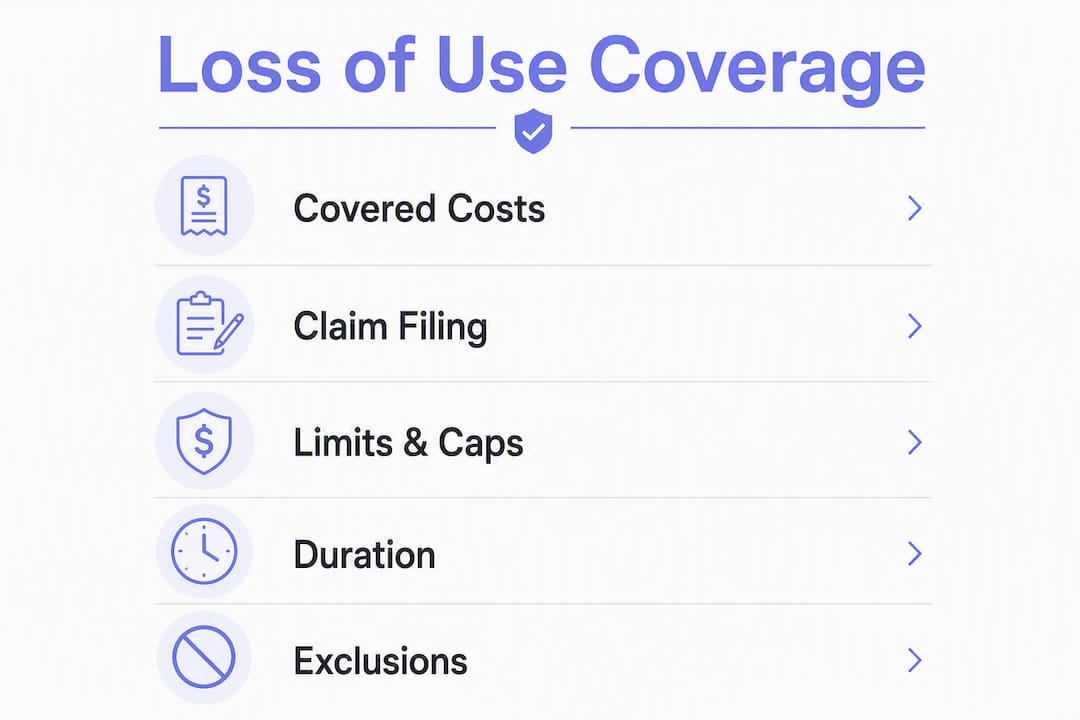
Loss of use coverage, also called additional living expenses (ALE) insurance, pays the extra costs you rack up when a covered loss makes your home unlivable. It does not cover your regular mortgage or utility bills. It covers the gap between what you normally spend to live and what you are forced to spend while your home is being repaired.
Typical payouts include:
- Hotel stays or short-term rental costs
- Restaurant meals above your normal grocery spending
- Laundry, storage, and temporary furniture rental
- Pet boarding and extra transportation
- Phone or internet fees tied to the displacement
That gap-based reimbursement model is the detail most people miss. If you normally spend $600 a month on groceries and you are now spending $900 eating out, your insurer owes you $300 a month on meals, not $900.
Table of Contents
- What loss of use coverage actually pays for
- Who has this coverage and where to find it on your policy
- How limits and payments are calculated
- How long ALE lasts and what it does not cover
- How to file a loss of use claim step by step
- ALE vs. fair rental value, and when official orders matter
- Is your current ALE limit actually enough?
- Key Takeaways
- Roman-insurance can help you get this right
What loss of use coverage actually pays for
Additional living expenses cover a wider range of costs than most policyholders expect, but the “additional” qualifier is doing real work in that phrase.
Temporary housing is the biggest line item. A hotel, extended-stay property, or short-term rental qualifies as long as the cost is reasonable for your area. Your insurer will not pay for a suite at a luxury resort when a mid-range extended-stay property is available nearby.
Meals are reimbursed on the difference model above. Keep your pre-loss grocery receipts or bank statements so you have a documented baseline. Without that baseline, your adjuster will estimate one, and their estimate will likely be lower than your actual spending.
Storage is covered when you need to move furniture or belongings out of a damaged home during repairs. So is temporary furniture rental if the unit you are staying in is unfurnished and the repair timeline is long.
Pet boarding often surprises people. If your short-term rental does not allow pets, the boarding cost is a legitimate ALE expense. Same logic applies to transportation: if you are temporarily living farther from work, the extra commuting cost above your normal spend is reimbursable.
One less obvious scenario: ALE can apply even when your home has no physical damage. If a covered peril knocks out electricity, water, or sewer service to your neighborhood and your home is uninhabitable as a result, the coverage can still kick in. Your insurer may offer an alternative remedy, like installing a generator, instead of paying ALE. If that remedy genuinely restores habitability, they can make that call.
ALE does not cover flood or earthquake losses unless you have purchased those coverages separately. A mandatory evacuation triggered by wildfire, hurricane, or tornado is a covered scenario under most standard policies. A flood evacuation is not, unless you carry a separate flood policy.
Who has this coverage and where to find it on your policy
Most residential policies include some form of loss of use protection, but the label varies by policy type:
- Homeowners policies list it as Coverage D or “loss of use.” It sits on your declarations page alongside Coverage A (dwelling), B (other structures), and C (personal property).
- Renters policies call it “additional living expenses” or ALE. It works the same way, covering the gap between your normal rent and what you pay for temporary housing.
- Condo policies typically include ALE as well, though the dwelling limit it is calculated against may be smaller since the condo association’s master policy covers the building structure.
The policy label matters when you are reading your declarations page. Look for “Coverage D,” “loss of use,” or “additional living expenses” and note two numbers: the dollar limit and any time cap. Both constrain your claim.
Fair rental value is a separate sub-coverage that sometimes appears under Coverage D. It applies to landlords, not tenants. If you own a rental unit and a covered loss forces your tenant to vacate, fair rental value compensates you for the lost rental income during repairs. That is a fundamentally different claim type from ALE, even though both can sit under the same coverage letter. Renters filing an ALE claim and landlords filing a fair rental value claim are using different parts of the same section for entirely different purposes.
Pro Tip: Pull up your declarations page right now and search for “Coverage D” or “loss of use.” Note the dollar limit and whether a time cap is listed. If you cannot find it or the limit looks low relative to your area’s rental market, that is a conversation to have with your agent before a loss happens.
How limits and payments are calculated
ALE limits are typically set as a percentage of your dwelling coverage, most commonly in the 10%–30% range. Many standard policies use 20% as the default.

| Dwelling Coverage (Coverage A) | ALE Limit at 20% | ALE Limit at 30% |
|---|---|---|
| $200,000 | $40,000 | $60,000 |
That dollar limit sounds substantial until you price out six months of extended-stay hotels in a mid-sized city. A $120-per-night hotel runs roughly $3,600 a month in lodging alone, before meals, transportation, or storage. A $40,000 ALE limit on a $200,000 dwelling policy covers about 11 months at that rate, assuming no other expenses. Add meals and transportation and that runway shrinks fast.
The reimbursement mechanics work like this: you pay the expense, save the receipt, and submit it to your insurer. Insurers pay the difference between your normal living costs and your temporary costs. They do not cut you a check for the full hotel bill. They cut you a check for the hotel bill minus what you would have spent on housing anyway.
Some insurers will pay vendors directly, particularly for lodging, when you ask upfront. If cash flow is tight after a loss, ask your adjuster on the first call whether direct payment or an advance is available. Most will not offer it unless you ask.
Per-day caps exist in some policies. A policy might cap ALE at $150 per day regardless of the percentage limit. Read both constraints because the binding one is whichever runs out first.
Pro Tip: Ask your agent to quote the cost of increasing your ALE limit from 20% to 30% of dwelling coverage. In most cases the premium difference is small, and the extra cushion matters most in markets where hotel and rental costs are high relative to home values.
How long ALE lasts and what it does not cover
ALE payments continue until one of three things happens: your home is habitable again, your dollar limit is exhausted, or your policy’s time cap runs out. Most standard policies impose a time limit on ALE coverage, and some provide for longer durations.
State law can override those caps after declared emergencies. California’s rules, for example, require a minimum of 24 months of ALE coverage after a state of emergency, with the possibility of extending to 36 months plus six-month increments for good cause when reconstruction delays are beyond the policyholder’s control. Tennessee does not have an identical statute, but state insurance department guidance and policy language still govern, and your insurer’s obligations are defined by both.
Common exclusions:
| Excluded Item | Why It Is Not Covered |
|---|---|
| Mortgage payments | ALE covers additional costs only; your regular housing obligation stays yours |
| Standard utility bills at the damaged home | These are normal costs, not additional ones |
| Flood or earthquake displacement | Excluded perils unless separate coverage is purchased |
| Voluntary relocation | ALE requires a covered loss to trigger; choosing to move does not qualify |
| Pre-existing vacancy | If the home was already vacant, there is no additional living cost to reimburse |
ALE does not cover your regular mortgage or ongoing fixed costs at your primary residence. That is the most common misconception. Your insurer is covering the gap, not your entire cost of living.
One more point worth flagging: ALE is subject to your policy deductible for the underlying loss. If a fire causes $80,000 in dwelling damage and your deductible is $2,500, you pay the deductible against the dwelling claim. The ALE claim is typically not separately deductible, but the underlying covered loss must exceed your deductible before any coverage applies.
How to file a loss of use claim step by step
Speed and documentation are the two variables you control after a loss. Here is the sequence that gets claims processed fastest.
- Secure safety first. Get everyone out, contact emergency services if needed, and do not re-enter until authorities clear the structure.
- Call your insurer immediately. Report the loss, get a claim number, and ask specifically: “Am I eligible for additional living expenses, and can you authorize an advance or direct hotel payment today?”
- Document the damage before cleanup. Photograph and video every affected area. Do not discard damaged items until your adjuster has seen them or you have documented them thoroughly.
- Start your expense log the same day. Open a folder, physical or digital, and drop every receipt into it: hotel confirmation, restaurant receipts, rideshare records, storage invoices, pet boarding statements.
- Request an official habitability determination. If local authorities, a building inspector, or a health department have declared the property uninhabitable or issued an evacuation order, get that document in writing. It is your strongest leverage if the insurer disputes ALE eligibility.
- Submit receipts on a regular schedule. Do not wait until repairs are complete to submit. Send batches weekly or biweekly so reimbursements keep pace with your spending.
- Track the running total against your limit. Know where you stand relative to your dollar cap and time cap. If you are approaching either, contact your agent about options before the limit runs out.
Documentation checklist:
- Hotel or rental lease agreements and payment confirmations
- Restaurant and grocery receipts (both, to document the gap)
- Transportation receipts: rideshare, mileage logs, rental car invoices
- Storage unit contracts and payment records
- Pet boarding invoices
- Official evacuation or uninhabitable orders from local authorities
- Repair estimates and contractor timelines
- Photos and video of all damage
Without receipts, claims are routinely denied. That is not a technicality. It is the standard the policy requires.
Pro Tip: Create a shared cloud folder (Google Drive, Dropbox) the day of the loss and photograph every receipt before you lose it. Label files by date and category. If your claim goes to dispute, an organized, timestamped record is far more persuasive than a shoebox of crumpled paper.

For general claims documentation guidance, the claims evidence overview from Roman-insurance is a useful reference on what documentation supports a claim.
ALE vs. fair rental value, and when official orders matter
The distinction between ALE and fair rental value is one that trips up both policyholders and, occasionally, adjusters. ALE reimburses a displaced resident for increased living costs. Fair rental value compensates a property owner for rental income lost while a tenant cannot occupy the unit. Both can appear under Coverage D, but they serve entirely different people in entirely different situations.
If you own a home and live in it, you file an ALE claim. If you own a rental property and your tenant is displaced, you file a fair rental value claim. If you are a renter whose landlord’s policy covers fair rental value, that is between your landlord and their insurer. Your ALE claim comes from your own renters insurance coverage.
Official habitability determinations carry real weight in disputes. Regulators advise using health department or government orders declaring a property or area unsafe as documentation to compel insurers to maintain ALE benefits until the area is officially declared safe again. If your insurer is pushing back on eligibility or trying to end payments before your home is genuinely livable, a written order from a local building official or health department is the document that changes that conversation.
For disputes that escalate, the National Association of Insurance Commissioners (NAIC) provides consumer guidance and can direct you to your state insurance commissioner’s office. Your state insurance department can intervene when an insurer is not honoring a valid claim. In Tennessee, that is the Tennessee Department of Commerce and Insurance.
Is your current ALE limit actually enough?
Most people discover their ALE limit is inadequate at the worst possible moment: after a loss, when they are already stressed and displaced. A quick pre-loss review takes 15 minutes and can save months of financial strain.
Signs your current limit may fall short:
- Your dwelling is insured for $300,000 or more and your ALE limit is only 10% ($30,000)
- Local hotel rates in your area run $100–$150 per night or higher
- You have pets that require boarding
- You have household members with medical equipment or special needs that limit housing options
- Your home’s rebuild timeline would likely exceed six months (older construction, custom features, supply chain delays)
- You own a multi-family property and need to cover both your own displacement and lost rental income
The 20% rule is a reasonable starting point. For a $400,000 dwelling, that is $80,000 in ALE, which covers roughly 18–22 months of moderate temporary housing costs in most Tennessee markets. If your home is high-value, custom-built, or located where rental inventory is thin, 30% is worth pricing out.
A practical sizing exercise:
- Estimate your current monthly housing cost (mortgage or rent).
- Research the going rate for a comparable short-term rental or extended-stay hotel in your area.
- Calculate the monthly gap between the two.
- Multiply by 12 (or 18 for a more conservative estimate).
- Compare that number to your current ALE dollar limit.
If the math does not work, ask your agent to quote an increased limit. The premium difference is usually modest relative to the protection it adds.
Key Takeaways
Loss of use coverage pays the gap between your normal living costs and your temporary costs after a covered loss, not your full expenses, and not your regular mortgage or bills.
| Point | Details |
|---|---|
| ALE covers the gap, not everything | Reimbursement equals temporary costs minus your normal baseline spending. |
| Limits are percentage-based | Most policies set ALE at 10%–30% of dwelling coverage; 20% is a common default. |
| Receipts are non-negotiable | Claims without documented receipts are routinely denied; start your log the day of the loss. |
| Official orders strengthen disputes | A written habitability or evacuation order from local authorities is your best leverage if an insurer contests eligibility. |
| Roman-insurance can review your limits | A policy review with Roman-insurance confirms whether your ALE limit fits your actual local housing costs. |
A note from the agent
After helping West Tennessee homeowners and renters through fire losses, storm damage, and displacement claims, the pattern I see most often is the same: people who kept organized records and called us immediately got reimbursed faster and with far less friction. The ones who waited, or assumed their insurer would track everything, spent months chasing payments.
If you are not sure what your ALE limit is or whether it is enough for your situation, that is exactly the kind of question we are here to answer before a loss happens. Roman-insurance serves families across West Tennessee, and a policy review costs you nothing.
Roman-insurance can help you get this right
Knowing your ALE limit exists is one thing. Knowing whether it is sized correctly for your home’s value, your local rental market, and your household’s specific needs is another. Roman-insurance works with homeowners and renters across West Tennessee to review existing policies, identify coverage gaps, and adjust limits before a loss forces the issue.
For homeowners, the starting point is a review of your homeowners insurance policy to confirm your Coverage D limit, check for time caps, and price out an increase if your current ALE percentage does not match your area’s rental costs. Renters can do the same through a renters policy review. Both take less than 30 minutes and can be done over the phone or in person at our office near the 38002 area.
If you are already in the middle of a claim and need help understanding what your policy covers, call Roman-insurance directly. We can walk through your declarations page with you, help you organize your documentation, and connect you with your Allstate claims team. Reach out today to schedule a policy review or get a quote.
Useful sources
- NAIC: What Are Additional Living Expenses and How Can Insurance Help?
- FEMA: Disaster Assistance and Housing Resources
This article provides general information about insurance coverage and is not a substitute for professional advice. Policy terms, limits, and exclusions vary. Confirm your specific coverage with your insurer or a licensed agent.