Boat liability insurance is defined as coverage that pays for bodily injury and property damage you cause to others while operating your vessel. Most states do not legally require it, yet serious accident claims routinely exceed $100,000. Industry standards for 2026 recommend minimum liability limits of $300,000 to $500,000. Without that protection, a single collision, a dock strike, or an injured passenger can expose your personal finances to a lawsuit that wipes out savings, property, and retirement accounts. Roman-insurance works with boat owners across West Tennessee to make sure that never happens.
What does boat liability insurance cover?
Boat liability insurance covers your legal responsibility when your vessel causes harm to other people or their property. It does not cover damage to your own boat. That distinction matters because many boat owners assume their policy protects everything, then discover the gap only after a claim.
Liability coverage specifically pays for medical bills, property damage, and environmental cleanup costs such as fuel spills. A fuel spill cleanup can cost tens of thousands of dollars on its own, and that expense falls entirely on the boat operator without liability protection.
The core areas a standard marine liability policy addresses include:
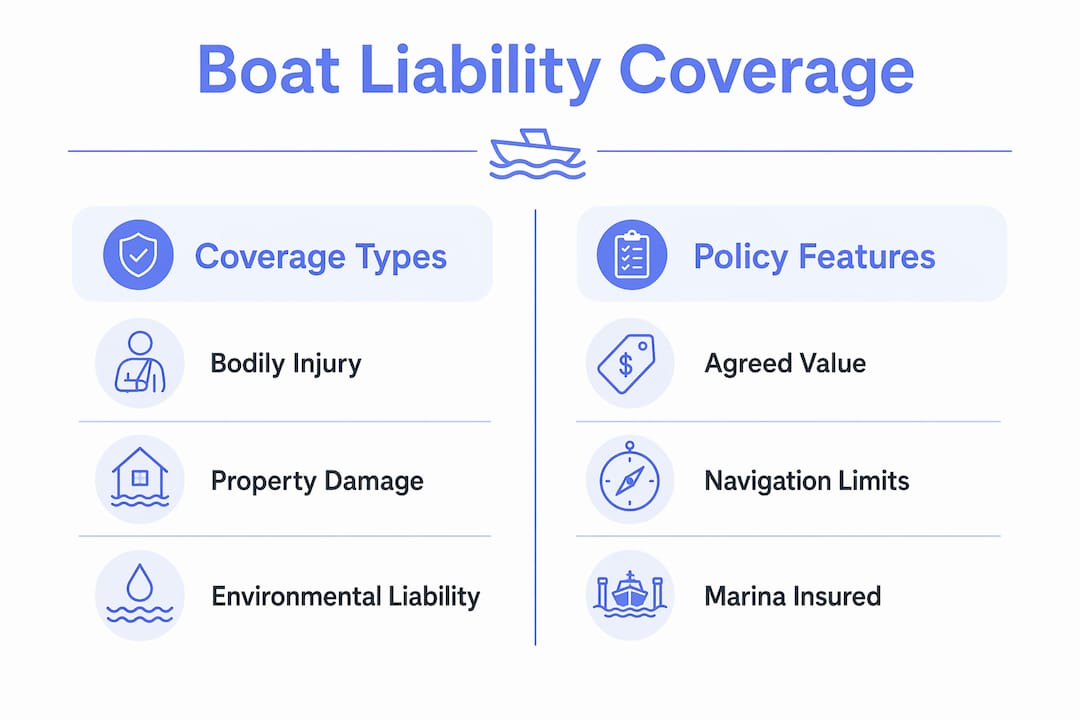
- Bodily injury liability. Pays medical expenses, lost wages, and legal damages for passengers or third parties injured by your boat.
- Property damage liability. Covers damage to other vessels, docks, marinas, and waterfront structures your boat strikes.
- Environmental liability. Funds cleanup costs for fuel or oil spills caused by your vessel.
- Legal defense costs. Pays attorney fees and court costs if someone sues you after an incident.
Liability coverage is separate from hull coverage, medical payments coverage, and uninsured boater coverage. Medical payments coverage pays for your passengers’ medical costs regardless of fault. Liability coverage, by contrast, responds only when you are legally responsible for someone else’s injury or loss. Knowing the difference prevents you from buying the wrong limits for the wrong risk.
Pro Tip: Ask your agent to confirm that your policy includes environmental liability. Not every base policy includes fuel spill cleanup by default, and the cost of omitting it can be severe.
Are you required by law to have boat liability insurance?
Most states do not mandate boat insurance, but that legal gap does not mean you can safely skip coverage. The financial exposure from an uninsured incident is the same whether or not a law requires the policy.
Only a few states, including Arkansas and Utah, require liability insurance for boats with engines over 50 horsepower. Every other state leaves the decision to the boat owner. That creates a false sense of security for many recreational boaters.
Even where state law is silent, two other parties often step in with their own requirements:
- Marinas. Marinas generally require proof of liability insurance with minimum limits of $100,000 to $300,000, and they typically require the marina to be named as an additional insured on your policy. Without that documentation, you cannot rent a slip.
- Lenders. If you financed your boat, your lender almost certainly requires you to carry insurance as a condition of the loan. Dropping coverage can trigger a loan default.
- Yacht clubs and organized events. Many clubs and regattas require proof of liability coverage before you can participate.
- Waterway authorities. Some managed waterways and state parks require proof of insurance at the launch ramp.
The practical reality is that most active boat owners face at least one of these requirements. Carrying liability coverage is not just a legal question. It is a financial self-defense decision.
Pro Tip: Before you dock at a new marina, call ahead and ask for their specific insurance requirements in writing. Showing up without the right limits or additional insured endorsement can cost you the slip.
How do coverage limits, agreed value, and navigation territory affect your protection?
Policy features shape how much protection you actually receive when a claim happens. Choosing the wrong features can leave you underinsured even when you technically have a policy in force.
Coverage limits and umbrella policies
The recommended minimum liability limit is $300,000 to $500,000, based on the frequency of serious accident claims exceeding $100,000. A single multi-person injury accident can push well past $500,000 in medical bills and legal costs. Boat owners with significant assets should consider a personal umbrella policy, which extends liability protection to $1,000,000 or more above the underlying boat policy limit. The cost of an umbrella policy is modest relative to the protection it adds.
Agreed value vs. actual cash value
Policy valuation affects your payout on a total loss claim. Agreed value policies pay the full insured amount without depreciation. Actual cash value (ACV) policies deduct depreciation, which can reduce your payout by 30–50% on an older vessel. For boats worth more than $25,000, agreed value coverage is the stronger choice. The premium difference is real but usually smaller than the depreciation gap on a total loss.
| Feature | Agreed value | Actual cash value |
|---|---|---|
| Payout on total loss | Full insured amount | Insured amount minus depreciation |
| Best for | Boats over $25,000 | Older, lower-value boats |
| Premium cost | Slightly higher | Lower |
| Depreciation risk | None | 30–50% reduction possible |
Navigation territory restrictions
Traveling outside your policy’s designated navigation territory can void your coverage entirely. This is one of the most overlooked risks in recreational boating. A policy written for inland Tennessee lakes does not automatically cover a trip to coastal Gulf waters. If you plan to extend your cruising range, notify your insurer before you go, not after an incident occurs.
Naming marinas as additional insured
Marinas almost universally require boat owners to name them as additional insured on liability policies. This protects the marina if your boat causes damage to their property or another vessel in their care. Failing to add this endorsement can result in losing your slip or facing a coverage dispute after a dock incident.
How to choose the right boat liability coverage for your situation
Selecting the right coverage starts with an honest assessment of how, where, and how often you use your boat. A pontoon boat used on a small lake carries different risk than a 40-foot cruiser operating in open water with frequent guests aboard.
Key factors that shape your coverage needs:
- Boat type and value. Larger, faster, and more expensive vessels carry more liability exposure and justify higher limits.
- Passenger frequency. The more guests you regularly carry, the greater your bodily injury exposure.
- Geographic range. Coastal or offshore boating requires broader navigation territory and often higher limits than inland lake use.
- Mooring location. Boats kept at busy marinas face more property damage exposure than those stored on trailers at home.
- Loan status. Financed boats require lender-mandated coverage levels regardless of your personal preference.
Boat owners should review their insurance policies annually, especially after purchasing new equipment, adding electronics, or changing their primary boating area. A policy written for last year’s usage may not match this year’s reality. If you switch insurance companies or update your policy mid-year, confirm that all coverage features carry over correctly.
Common add-ons worth considering include on-water towing and assistance, which covers the cost of a tow if your engine fails, and medical payments coverage for passenger injuries regardless of fault. These are inexpensive additions that fill gaps a pure liability policy leaves open.
Mid-size boat premiums average $500 to $1,500 annually, with liability limits and navigation territory being the two largest cost drivers. Raising your liability limit from $100,000 to $300,000 typically adds far less to your premium than most boat owners expect.
Pro Tip: Bundle your boat policy with your home or auto coverage when possible. Carriers often discount both policies, and having everything with one insurer simplifies claims coordination.
What happens when a liability claim occurs on the water?
A liability claim begins the moment your boat causes injury or property damage to someone else. How you respond in the first hours after an incident directly affects how smoothly the claim resolves.
- Stop and render aid. Federal and state law requires you to assist anyone injured in a boating accident. Leaving the scene creates criminal exposure on top of civil liability.
- Document the scene. Take photos of all vessels involved, the damage, the location, and any visible injuries. Collect names and contact information from witnesses.
- File a report. Most states require a formal accident report when injuries, fatalities, or property damage above a threshold amount occur. Tennessee requires reporting for accidents involving death, injury, or damage exceeding $2,000.
- Notify your insurer promptly. Call your insurance company the same day. Late notification can complicate or delay your claim. Your insurer assigns an adjuster who manages the investigation and communicates with the other party.
- Do not admit fault. Cooperate fully with your insurer and with authorities, but avoid making statements about fault at the scene. Let the investigation determine liability.
Your liability policy covers legal defense costs in addition to damages. If the other party files a lawsuit, your insurer provides and pays for legal representation up to your policy limit. That defense benefit alone justifies carrying adequate limits, since attorney fees in a contested boating injury case can reach six figures before a verdict is reached.
Key takeaways
Boat liability insurance is the single most critical coverage a boat owner can carry, and the recommended minimum of $300,000 to $500,000 in liability limits reflects the real cost of serious on-water accidents.
| Point | Details |
|---|---|
| Liability covers others, not your boat | It pays for bodily injury and property damage you cause to third parties, not your own vessel. |
| Minimum limits should be $300,000–$500,000 | Serious accident claims routinely exceed $100,000, making lower limits a financial risk. |
| Navigation territory matters | Traveling outside your policy’s defined area can void all coverage, including liability. |
| Marinas require additional insured status | Most marinas mandate $100,000–$300,000 in liability and require being named on your policy. |
| Annual policy review is non-negotiable | Changes in equipment, usage, or cruising range require a policy update, not just a renewal. |
Why I think most boat owners are dangerously underinsured
After years of watching how boat insurance claims actually play out, the pattern I see most often is not fraud or negligence. It is underestimation. Boat owners look at a $100,000 liability limit and think it sounds like a lot of money. Then a collision injures two people, one of whom misses six months of work, and that $100,000 is gone before the first deposition.
The coverage detail that surprises people most is environmental liability. A fuel spill in a marina basin is not just an insurance problem. It is a federal regulatory problem. The Coast Guard and the EPA both have authority to assess cleanup costs, and those costs can dwarf the property damage from the incident that caused the spill. Most boat owners have never thought about this.
The other mistake I see regularly is ignoring navigation territory. Someone buys a policy for lake use in Tennessee, then takes the boat to the Gulf Coast for a long weekend, and assumes they are covered because they have a policy. They are not. That gap is not a technicality. It is a complete loss of protection at exactly the moment when offshore conditions make an incident most likely.
My honest advice is to treat your boat insurance coverage the way you treat your boat’s engine maintenance. Review it every year, not just when something goes wrong. If your boating habits have changed, your policy needs to change with them.
— josh
Roman-insurance can protect what you’ve built on the water
Protecting your boat means more than covering the hull. The liability exposure from a single on-water incident can reach into your home equity, your savings, and your future income.
Roman-insurance serves boat owners across West Tennessee with personalized coverage advice and access to policies that match how you actually use your vessel. Whether you need a standalone marine liability policy or want to bundle your boat coverage with your homeowners insurance for a better rate, the team at Roman-insurance can walk you through your options. Get a personalized quote and find out exactly what coverage your situation requires.
FAQ
What is the minimum liability limit for boat insurance?
Industry standards recommend a minimum of $300,000 to $500,000 in liability coverage, because serious boating accident claims frequently exceed $100,000 in medical and legal costs.
Does boat liability insurance cover fuel spills?
Yes, most marine liability policies include environmental liability coverage that pays for fuel and oil spill cleanup costs. Confirm this feature is explicitly included in your policy, as it is not always part of a base policy.
Do I need boat insurance if my state does not require it?
You likely still need it. Marinas require proof of liability coverage with limits of $100,000 to $300,000 as a condition of docking, and lenders require it if your boat is financed.
What is the difference between agreed value and ACV in a boat policy?
Agreed value pays the full insured amount on a total loss with no depreciation deducted. ACV policies reduce the payout by 30–50% based on the boat’s depreciated market value at the time of the claim.
How often should I review my boat insurance policy?
Review your policy at least once a year, and immediately after any significant change such as adding equipment, changing your cruising area, or taking on more frequent passengers.