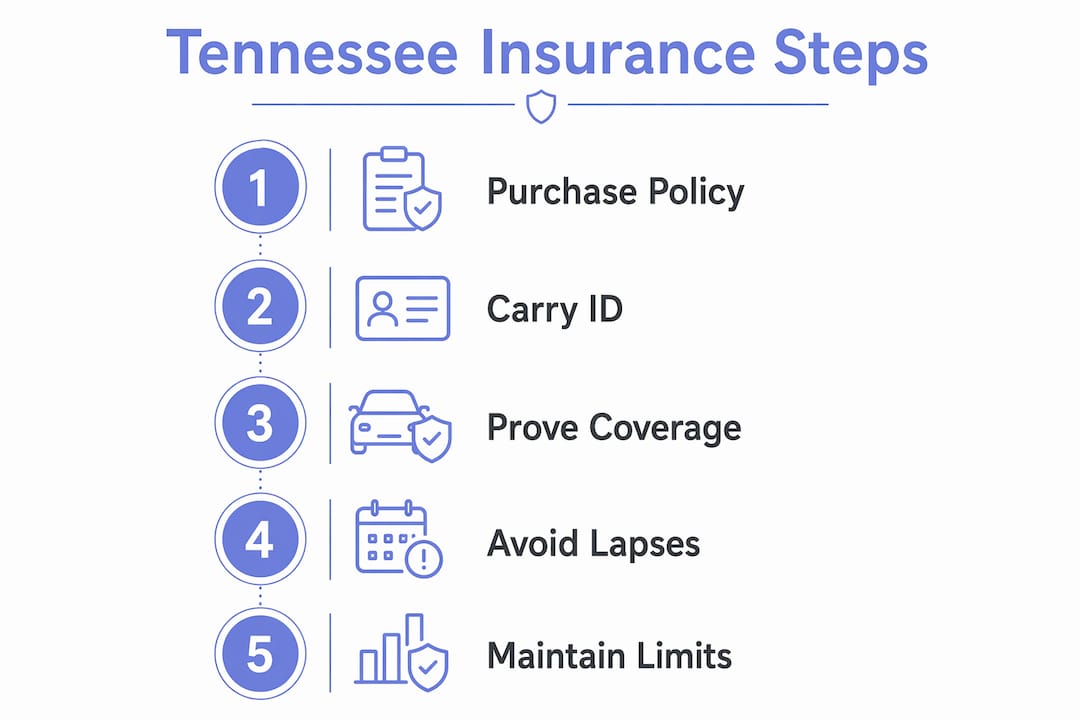
Tennessee law requires every driver to carry bodily injury liability and property damage liability meeting the standard known as 25/50/25 — or otherwise demonstrate financial responsibility before operating a vehicle on public roads. This isn’t optional paperwork. Under the Financial Responsibility Law, you must be able to prove coverage at registration and any time you’re behind the wheel.
The three numbers break down simply:
- $25,000 — maximum the insurer pays for one person’s injuries in a crash you cause
- $50,000 — maximum for all injuries combined in a single accident
- $25,000 — maximum for property damage you cause to others
Tennessee’s Financial Responsibility Law exists to protect everyone on the road — not just the driver who carries insurance, but every person they might injure or whose property they might damage. Driving without it shifts the financial burden onto victims who did nothing wrong.
Roman-insurance helps West Tennessee drivers meet these requirements quickly, with immediate proof of insurance issuance and local agent support near the 38002 area.
Table of Contents
- What the 25/50/25 limits actually mean for Tennessee drivers
- How to prove financial responsibility in Tennessee
- Penalties for driving without proof of financial responsibility
- How Tennessee’s EIVS catches uninsured drivers automatically
- Why state minimums often aren’t enough coverage
- What to do when you’re stopped or involved in an accident
- Exemptions and special cases you should know about
- What a lapse actually costs you in time and money
- How to buy the right coverage in Tennessee
- Key Takeaways
- The mistake most Tennessee drivers don’t realize they’re making
- Roman-insurance makes it easy to get compliant today
- Useful sources
What the 25/50/25 limits actually mean for Tennessee drivers
The numbers on your declarations page aren’t arbitrary. Each one caps what your insurer will pay in a specific scenario, and understanding the gap between those caps and real-world costs is what separates adequate coverage from a financial disaster.

Say you rear-end another car and injure two people. Person A has $18,000 in medical bills. Person B has $35,000. Your 25/50/25 policy pays $25,000 for Person B (the per-person cap), leaving $10,000 unpaid — and that remainder comes out of your pocket. The $50,000 per-accident cap means the total paid for both people combined won’t exceed $50,000 regardless of how many are hurt.
The property damage limit works the same way. Hit a newer vehicle worth $40,000 and your $25,000 limit leaves a $15,000 gap you owe directly.
| Coverage Type | Minimum Limit | What It Pays |
|---|---|---|
| Bodily injury per person | $25,000 | One injured person’s medical costs |
| Bodily injury per accident | $50,000 | All injured parties combined |
| Property damage per accident | $25,000 | Damage to others’ vehicles or property |
Which vehicles must carry 25/50/25:
- All passenger vehicles registered in Tennessee
- Motorcycles (same 25/50/25 minimums apply)
- Leased and financed vehicles (plus lender-required collision and comprehensive)
Commercial-plated vehicles operate under a different framework and typically require commercial auto policies with higher limits than the passenger-vehicle minimums.
The state minimum is a floor, not a recommendation. Most insurance professionals consider 25/50/25 dangerously low for anyone with a home, savings, or income to protect.
Pro Tip: If you’re financing or leasing your vehicle, your lender contractually requires collision and comprehensive coverage — the state doesn’t mandate it, but your loan agreement does. Skipping it can trigger a force-placed policy from the lender at a much higher premium.
How to prove financial responsibility in Tennessee
The most common and practical way to satisfy Tennessee’s requirement is an active liability insurance policy that meets the 25/50/25 minimum. But the state does recognize a few alternatives.
Accepted forms of proof:
- Insurance ID card (paper or electronic) issued by your insurer
- Insurer-issued declarations page or binder showing active coverage
- Electronic verification through Tennessee’s EIVS system (your insurer reports directly to the state)
Statutory alternatives — legal but rarely practical:
- A $65,000 surety bond filed with the Department of Revenue
- A $65,000 cash deposit with the Department of Revenue
The bond and cash deposit options exist for self-insured individuals or businesses, but they tie up a significant amount of capital and offer none of the claims-handling support an insurer provides. For the vast majority of Tennessee drivers, a standard liability policy is the only sensible path.
SR-22 filings are a separate matter. If a court or the state requires you to file an SR-22, your insurer submits that certificate directly to the Department of Revenue as proof of financial responsibility. It’s typically required after serious violations like a DUI or driving uninsured.
Posting a $65,000 bond sounds like a workaround, but it’s a last resort for a reason — you’re putting up real money with no coverage for your own vehicle or medical costs, and you still bear full claims liability.
Pro Tip: Save a photo of your insurance ID card in your phone’s camera roll AND add your insurer’s claims number as a contact. If you’re stopped and your phone is low on battery, you can pull up the card without unlocking apps.
Penalties for driving without proof of financial responsibility
Getting caught without valid insurance in Tennessee isn’t just a ticket. The consequences stack up fast and can follow you for months.
Immediate and administrative penalties:
- Fines for failure to maintain financial responsibility under the Tennessee penalty statute
- Vehicle registration suspension
- Potential driver’s license suspension for repeat or serious violations
- A registration STOP that prevents renewal until proof is provided and fees are paid
The on-road consequence is straightforward: a police officer who can’t verify your coverage can cite you on the spot. The administrative consequence is slower but more disruptive. The state’s EIVS system flags gaps between registered vehicles and active policies, and a notice goes out requiring you to respond within a set window.
Reinstatement requires:
- Obtaining a valid policy that meets 25/50/25
- Submitting proof to the Department of Revenue
- Paying any applicable reinstatement fees
- Waiting for the STOP to clear before renewing registration
Pro Tip: If you discover a lapse — even a short one between policies — contact your insurer immediately and request a binding declaration. Getting that document to the Department of Revenue quickly can prevent a full registration suspension before it’s formally issued.
How Tennessee’s EIVS catches uninsured drivers automatically
Tennessee’s Electronic Insurance Verification System runs in the background every time your registration is active. Insurers report policy status directly to the state, and the system cross-references that data against registered vehicles continuously.
What triggers a notice:
- A policy cancellation or lapse reported by your insurer
- A gap between the end of one policy and the start of another
- A reporting error by the insurer (yes, these happen)
- Failure to update insurer information after switching carriers
When the system flags a gap, the Department of Revenue sends a notice giving you a window to respond with proof of coverage. If you don’t respond in time, a registration STOP is placed on your vehicle. That STOP means you can’t renew your registration until the issue is resolved and fees are cleared.
The James Lee Atwood Jr. Law, enacted as part of 2017 reforms, formalized this web-based verification and strengthened the penalties for uninsured drivers. Before that law, enforcement was largely reactive. Now it’s automated.
If you receive a notice from the Department of Revenue about a coverage gap, don’t ignore it. Even if you believe you were covered, respond immediately with your declarations page or have your agent submit proof directly. Insurer reporting errors are real, and they can trigger a STOP on a vehicle that was never actually uninsured.
What to do when you get a notice:
- Contact your insurer the same day and request written proof of continuous coverage
- Have your agent submit the proof directly to the Department of Revenue
- Keep a copy of everything submitted and note the date
Why state minimums often aren’t enough coverage
The 25/50/25 floor was designed to ensure minimum accountability, not to protect your assets. Insurance professionals consistently recommend higher limits for anyone with a home, retirement savings, or steady income.
The math is simple. A serious accident with multiple injuries can easily exceed $50,000 in medical costs. Once your policy limit is exhausted, your personal assets — savings, home equity, future wages — are exposed to a lawsuit. The state minimum does nothing to protect your own vehicle either. Hit a deer, get hail damage, or have your car stolen, and a 25/50/25 policy pays nothing toward your loss.
Coverages worth adding beyond the minimum:
- Higher liability limits — 100/300/100 is a common recommendation from professionals; it costs less than most drivers expect
- Collision coverage — pays for your vehicle after an accident regardless of fault
- Comprehensive coverage — covers theft, weather, and non-collision damage
- Uninsured/underinsured motorist (UM/UIM) — critical in Tennessee, where a meaningful share of drivers carry no insurance
- Umbrella policy — adds a layer of liability protection above your auto and home limits
A practical rule: match your bodily injury limits to your net worth and future-earnings exposure. For most homeowners, 100/300 liability plus an umbrella policy is a cost-effective way to close the gap. You can explore full coverage options specific to Tennessee drivers to see what makes sense for your situation.
Pro Tip: A local agent can run a quick asset-and-liability review in about 15 minutes. Roman-insurance does this routinely for West Tennessee clients — it often reveals that upgrading from 25/50/25 to 100/300/100 costs less per month than a tank of gas.
What to do when you’re stopped or involved in an accident
Being prepared before something happens makes the actual moment much less stressful.
If you’re stopped by police:
- Pull over safely and turn off the engine.
- Provide your driver’s license, vehicle registration, and proof of insurance — paper card, electronic image, or the officer can verify through EIVS.
- Stay calm and answer basic questions; you’re not required to explain your route or destination.
- If you can’t produce proof immediately, note the officer’s name and badge number and contact your insurer the same day.
After an accident:
- Check for injuries and call 911 if anyone is hurt.
- Move vehicles out of traffic if it’s safe to do so.
- Exchange name, contact info, license plate, insurer name, and policy number with the other driver.
- Document the scene thoroughly.
- Call your insurer to report the accident before leaving the scene if possible.
Scene documentation checklist:
- Photos of all vehicles, damage, license plates, and road conditions
- Names and contact info of any witnesses
- Police report number (get it before you leave)
- Your insurer’s claim reference number
Medical attention matters even when you feel fine. Some injuries — whiplash, internal trauma — don’t present symptoms immediately. Seeking care within 24–48 hours creates a medical record that connects your injuries to the accident, which protects your claim.
Pro Tip: Never admit fault at the scene, even if you think you caused the accident. Fault is determined by insurers and sometimes courts based on evidence. A casual “I’m sorry” can be used against you in a claim.
Exemptions and special cases you should know about
Leased and financed vehicles
The state requires 25/50/25. Your lender requires more. Lenders and lessors contractually mandate collision and comprehensive coverage for any vehicle with an active loan or lease. If you drop those coverages, the lender can force-place a policy on your vehicle at a significantly higher cost and add it to your loan balance.
Out-of-state drivers
If you’re visiting Tennessee with an out-of-state policy, Tennessee generally recognizes your home state’s coverage as long as it meets or exceeds 25/50/25. If your home state has lower minimums, you’re expected to carry the Tennessee equivalent while driving here.
Motorcycles and mopeds
Motorcycle insurance minimums in Tennessee mirror the passenger-vehicle standard: $25,000 per person, $50,000 per accident, $25,000 property damage. Helmet laws apply to riders under 21. Mopeds and motor-driven cycles have distinct registration and insurance treatments — check with the Department of Revenue for the specific classification of your vehicle. Roman-insurance offers motorcycle and ATV coverage for riders across West Tennessee.
Commercial-plated vehicles
Passenger-vehicle minimums don’t apply to commercially tagged vehicles. Commercial auto policies carry higher liability requirements and are structured differently. If you use a personal vehicle for business purposes, talk to your agent about whether your personal policy covers commercial use — many don’t.
Pro Tip: If you’re switching insurers, make sure your new policy’s effective date overlaps with your old policy’s cancellation date by at least one day. Even a 24-hour gap can trigger an EIVS flag. Read more about how to switch insurance companies without creating a lapse.
What a lapse actually costs you in time and money
A coverage lapse isn’t just a legal problem — it’s an administrative one that takes real time and money to resolve.
Typical timeline after a lapse is flagged:
- EIVS flags the gap and the Department of Revenue issues a notice
- You have a limited window (typically 30 days) to respond with proof
- Failure to respond results in a registration STOP
- Reinstatement requires proof of coverage, payment of fees, and processing time
| Action | Typical Cost or Timeframe |
|---|---|
| Fine for failure to maintain financial responsibility | Varies by offense; statutory penalties apply |
| Registration reinstatement fee | Varies; contact Department of Revenue |
| Back premiums if policy lapsed | Depends on insurer and gap length |
| Time to clear a registration STOP | Days to weeks depending on response speed |
The fastest path through reinstatement is having your insurer or agent submit proof directly to the Department of Revenue. Agents who bundle policies and maintain continuous coverage records can often clear a STOP faster than drivers navigating the process alone.
Steps to reinstate after a lapse:
- Obtain a new or reinstated policy meeting 25/50/25 immediately
- Request a binding declarations page from your insurer the same day
- Submit proof to the Department of Revenue — your agent can do this on your behalf
- Pay all applicable fees and confirm the STOP has been lifted before driving
How to buy the right coverage in Tennessee
Buying coverage isn’t complicated, but doing it right the first time saves you from gaps, lender disputes, and EIVS flags.
Step-by-step buying process:
- Assess your assets. List your home equity, savings, and income. That number tells you how much liability exposure you’re protecting against.
- Choose your liability limits. Start at 25/50/25 if budget is tight, but seriously consider 100/300/100 if you own a home or have savings.
- Decide on collision and comprehensive. Required by lenders; worth carrying on any vehicle you couldn’t afford to replace out of pocket.
- Add UM/UIM coverage. Given the number of uninsured drivers on Tennessee roads, this is one of the most practical additions to any policy.
- Get quotes and compare. Provide your VIN, driver’s license number, and prior coverage dates for the fastest quote turnaround.
- Buy through a local agent. A local agent can submit proof directly to the state verification system and handle lender certificate requirements on the same call.
Matching your liability limits to your net worth isn’t just good advice — it’s the practical standard insurance professionals use. A homeowner with $200,000 in equity carrying 25/50/25 is one bad accident away from losing it.
The Roman-insurance auto page lets West Tennessee drivers get a quote and speak with a licensed local agent who knows the 38002 area and can handle lender requirements, bundling, and immediate proof submission in one conversation.
Pro Tip: Have these four things ready before you call an agent: your VIN, your driver’s license number, your prior policy’s expiration date, and the name of your previous insurer. That’s everything needed to issue a policy and submit proof to EIVS the same day.
Key Takeaways
Tennessee’s 25/50/25 minimum is a legal floor — not adequate protection for most drivers with assets — and proof of financial responsibility must be maintained continuously or the state’s EIVS will flag the gap automatically.
| Point | Details |
|---|---|
| Statutory minimum | 25/50/25: $25,000 per person, $50,000 per accident, $25,000 property damage. |
| Proof is mandatory | Carry an insurance ID card or electronic proof at all times; the state verifies coverage automatically. |
| Minimums leave gaps | State minimums don’t cover your vehicle or large claims; 100/300/100 is a common professional recommendation. |
| Lapses trigger enforcement | EIVS flags gaps quickly; respond to any Department of Revenue notice within the stated window to avoid a registration STOP. |
| Roman-insurance | Roman-insurance helps West Tennessee drivers get compliant fast with immediate proof issuance and local agent support. |
The mistake most Tennessee drivers don’t realize they’re making
Most drivers I talk to in West Tennessee think that having any insurance means they’re covered. They’re not wrong legally — but they’re often wrong practically. The 25/50/25 minimum was set as a floor for accountability, not as a number that reflects what a real accident actually costs in 2026. A two-car collision with injuries can hit $100,000 in medical bills before anyone leaves the hospital. At that point, a 25/50/25 policy has already run out, and the driver is personally on the hook for the rest.
The other mistake I see constantly is the gap between policies. Someone switches insurers to save $20 a month, and there’s a 48-hour window where neither policy is active. EIVS catches it, a notice goes out, and suddenly there’s a registration problem that takes weeks to clear. It’s entirely avoidable — overlap your policies by a day, or have your agent coordinate the switch so there’s no gap at all.
Local context matters here. West Tennessee drivers near the 38002 area tend to have real assets worth protecting: homes, vehicles, savings. Carrying the state minimum on a $400,000 home is a mismatch that a 15-minute conversation with a licensed agent can fix. That’s exactly what Roman-insurance does for clients in this area — not just sell a policy, but make sure the limits actually match what’s at stake.
Roman-insurance makes it easy to get compliant today
West Tennessee drivers who need coverage fast — or who want to make sure their current policy actually protects what they own — have a direct option in Roman-insurance. As a local Allstate agency serving the 38002 area and surrounding West Tennessee communities, Roman-insurance issues proof of insurance the same day, handles lender certificate requirements, and submits coverage confirmation directly to Tennessee’s EIVS so your registration stays clean.
Whether you’re starting from scratch, upgrading from the state minimum to full coverage, or sorting out a lapse before it becomes a registration STOP, a local agent who knows Tennessee’s requirements is the fastest path to getting it right. Bundling your auto with home or renters coverage through Roman-insurance also typically reduces your total premium.
Get a quote and speak with a local agent today at Roman-insurance auto insurance.
Useful sources
These are the authoritative references used throughout this article. Check them directly for the current legal text, official fee schedules, or to contact the relevant state department.
- Tennessee Financial Responsibility Law — TN.gov: The primary state source for the 25/50/25 minimums, accepted proof types, and the James Lee Atwood Jr. Law. Start here for any question about what the law requires.
- DIFD-1 Insurance Verification Overview — Tennessee Department of Revenue: Explains how EIVS works, what triggers a notice, and how to respond to a coverage gap flag.
- DIFD-14 Penalty for Not Meeting Financial Responsibility Requirements: The statutory penalty schedule for failing to maintain or produce proof of financial responsibility.
- Auto Insurance Consumer Information — Tennessee Department of Commerce and Insurance: Consumer-facing guidance on auto insurance basics, coverage types, and how to file complaints.
- Tennessee Motorcycle Insurance Minimum Requirements — DMV.ORG: Motorcycle-specific coverage minimums and registration notes for Tennessee riders.
This article is general information, not legal or professional insurance advice. Confirm current requirements and your specific situation with the Tennessee Department of Revenue or a licensed insurance professional.