
Yes, you can buy a life insurance policy for parents, and it’s more straightforward than most families expect. Two requirements must be in place before any application moves forward: your parents must give written consent, and you must demonstrate insurable interest in their lives. That second requirement simply means you’d face a real financial loss if they died, which is almost always true for adult children.
Here’s what that looks like in practice:
- Parental consent: Your parent signs the application or a separate consent form. No exceptions.
- Insurable interest: You share finances, co-signed debts, or depend on them in some way.
- Policy types available: Term life, whole life, final expense, guaranteed issue, and simplified issue.
- Age and health: Both affect what’s available and what it costs, especially for parents over 70.
- Your role: You can be the policy owner and beneficiary while your parent is the insured.
Once those boxes are checked, you have real options, from affordable term coverage to permanent policies built around end-of-life costs.
What are the legal requirements for insuring a parent?
Two legal pillars support every policy you buy on a parent’s life: consent and insurable interest. Skip either one and no legitimate insurer will issue the policy.
Consent means your parent actively agrees to be insured. They’ll typically sign the application itself, confirming they understand the coverage and who benefits. This protects them from being insured without their knowledge, which is why the rule exists in the first place.
Insurable interest is the financial piece. You must show that your parent’s death would cause you a measurable financial loss. For adult children, this arises in several common ways:
- You co-signed a mortgage, car loan, or business debt with your parent.
- Your parent provides financial support to your household.
- You’d be responsible for their funeral and burial costs.
- You share ownership of property or a business.
Most states require insurable interest only at the time the policy is issued, not throughout its life. State insurance departments, including the Texas Department of Insurance, publish consumer guides that outline these rules clearly. If you’re unsure about your state’s specific requirements, a licensed agent can walk you through what documentation you’ll need before you apply.
Which types of policies work best for parents?
Not every policy type fits every parent’s situation. Age, health, and what you’re actually trying to cover all push you toward different options.
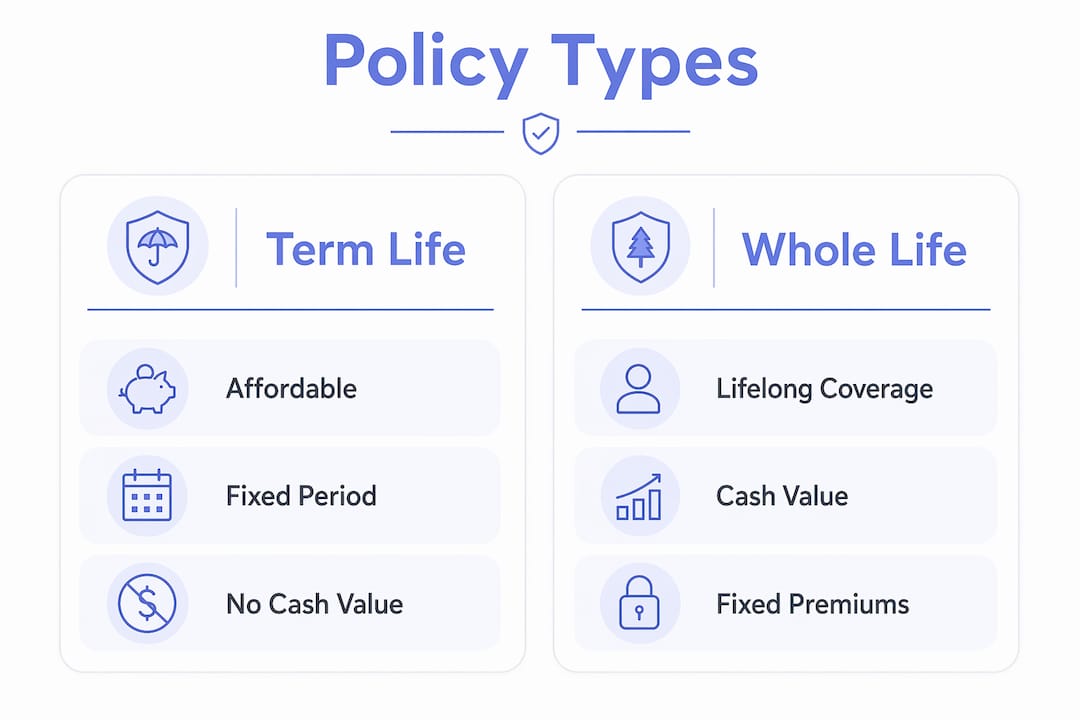
Term life insurance is the most affordable starting point. It covers a set period, typically 10, 20, or 30 years, and pays a death benefit if your parent dies during that term. Term life works well when the goal is covering a specific debt or replacing income for a defined window. The catch: premiums rise sharply with age, and parents over 70 may find term coverage either expensive or unavailable beyond a 10-year term.

Whole life insurance provides lifelong coverage and builds cash value over time. Premiums are fixed, the policy doesn’t expire, and the cash value can be borrowed against. The trade-off is cost. Whole life runs significantly higher in premiums than term, which makes it harder to justify unless your parent needs permanent coverage.
Final expense insurance is a small whole life policy, typically ranging from $5,000 to $25,000 in coverage, designed specifically to cover funeral costs, medical bills, and other end-of-life expenses. It’s one of the most practical options for seniors because approval is easier and the coverage amount matches the actual need. Final expense policies don’t require a medical exam in most cases.
Guaranteed issue and simplified issue policies exist for parents whose health makes traditional underwriting difficult. Guaranteed issue accepts applicants ages 50–85 regardless of health, but premiums are higher and death benefits are smaller. Simplified issue requires answering a few health questions but skips the full medical exam.
Pro Tip: Match the policy type to the specific financial goal. If you’re covering a $15,000 funeral, final expense insurance is cleaner and cheaper than a $500,000 term policy your parent may not qualify for.
How to buy life insurance for your parents: step by step
The process is more manageable when you break it into clear stages. Here’s how it typically works:
1. Define the coverage goal. Are you covering funeral costs, paying off a mortgage, or replacing income your parent provides? A standard rule of thumb is 10 times annual income or enough to cover outstanding debts and future support needs. Knowing the number before you shop keeps you from over-buying or under-buying.
2. Have the conversation with your parent. This step trips up more families than the paperwork does. Your parent needs to understand what you’re purchasing and why. The Conversation Project offers free resources to help families discuss end-of-life financial planning without it becoming an uncomfortable standoff.
3. Gather documentation. You’ll need your parent’s Social Security number, date of birth, and basic health history. You’ll also need documentation supporting your insurable interest, such as a co-signed loan agreement or proof of financial dependency.
4. Compare policies from multiple insurers. Premiums for the same coverage can vary widely between carriers. Families in the Memphis area can compare local rates to find options that fit both the coverage need and the budget.
5. Complete the application. Most applications include a health questionnaire. Your parent may need to answer questions about medical history, current medications, and lifestyle habits. For parents who want to skip the exam entirely, no-exam term policies are available through digital-first providers and offer faster approval.
6. Submit proof of consent and insurable interest. The application process requires both before the insurer will bind coverage. Keep copies of everything.
7. Set up premium payments and keep your parent informed. As the policy owner, you pay the premiums. Your parent should know the policy exists, where documents are stored, and how to reach the insurer if needed.

Cost and coverage: what drives the price up?
Premiums for a parent’s life insurance policy depend heavily on three variables: age, health, and policy type. The older and less healthy your parent is, the more you’ll pay, and premiums escalate significantly as age increases. A healthy 60-year-old will pay a fraction of what a 75-year-old pays for the same coverage amount.
Term life stays cheaper than whole life at every age bracket. If your parent is in their early 60s and in good health, a 10-year term policy can still be a cost-effective way to cover a specific debt. Once parents move past 70, final expense insurance often becomes the more practical choice because the coverage amount is smaller and the underwriting is looser.
A few other factors that affect cost:
- Riders: Add-ons like accidental death benefits or waiver of premium can increase the monthly cost but add meaningful protection.
- Coverage amount: Higher face values mean higher premiums. Match the coverage to the actual financial need rather than buying the largest policy available.
- Payment structure: Some policies allow single-premium or limited-pay options, where you pay for 10 or 20 years and the policy remains in force for life.
Comparison shopping across carriers is the single most effective way to control cost. Families working with a local agent, like those at Roman-insurance in Germantown, can get side-by-side comparisons without spending hours on hold with multiple insurers.
Is life insurance always the right call for elderly parents?
Not always. For parents over 75 with no outstanding debts, no financial dependents, and enough savings to cover their own funeral, a life insurance policy may cost more than it returns. Financial professionals often advise that elderly parents without obligations or dependents may be better served by a dedicated savings account or a funeral trust than by a monthly premium.
That said, guaranteed issue policies fill a real gap for parents who have health conditions that would disqualify them from traditional coverage. The premiums are higher and the death benefit is modest, but for a family with no other safety net, even $10,000 in coverage can prevent a financial crisis.
The honest question to ask is: what specific financial problem does this policy solve? If the answer is clear, the policy is probably worth it. If the answer is vague, a savings strategy may serve the family better.
Pro Tip: Before purchasing any policy for an elderly parent, list every financial obligation they carry: debts, ongoing support to family members, and estimated end-of-life costs. If the total is low and savings can cover it, redirect the premium dollars into a dedicated account instead.
Families exploring life insurance alternatives should also look at prepaid funeral plans, which lock in today’s prices for services and remove the burden from family members entirely.
How to manage existing coverage your parents already have
Before buying a new policy, find out what your parents already own. Many older adults have group life insurance through a former employer, a small whole life policy purchased decades ago, or a policy they’ve forgotten about entirely.
Start by asking your parent directly and checking any paperwork in their files. If they can’t recall, the FINRA BrokerCheck tool can help verify financial professionals who may have sold them a policy. For policies issued by insurers that have since merged or changed names, the state insurance department can often help trace the coverage.
Once you locate existing policies, review the beneficiary designations. Outdated beneficiaries, such as a deceased spouse or an ex-partner, are one of the most common and costly oversights in life insurance planning. Update them immediately if needed.
If your parent has a whole life policy with accumulated cash value, understand how that value factors into their overall financial picture before adding new coverage. Stacking policies without reviewing what’s already in force can lead to over-insurance and unnecessary premium costs.
Tax implications of life insurance for parents
Life insurance death benefits are generally paid income-tax-free to beneficiaries under federal law. If you’re the beneficiary of your parent’s policy, you typically receive the full payout without owing federal income tax on it.
A few situations can complicate that:
- Interest on delayed payouts: If the insurer holds the death benefit and pays it out with interest, the interest portion is taxable as ordinary income.
- Estate taxes: If your parent owns the policy and their estate exceeds the federal estate tax exemption, the death benefit may be included in the taxable estate. Transferring ownership of the policy to you or an irrevocable life insurance trust (ILIT) can remove it from the estate, though this requires careful planning and usually an attorney.
- Gift tax on premium payments: If you pay premiums on a policy your parent owns, those payments may be treated as gifts. Amounts above the annual gift tax exclusion could require filing a gift tax return, though actual tax owed is rare given the lifetime exemption.
The Consumer Financial Protection Bureau recommends that families coordinate life insurance decisions with broader estate planning, particularly when a power of attorney or trust is already in place. For anything involving estate tax exposure, a tax professional or estate attorney is worth the consultation fee.
Key Takeaways
Buying life insurance for a parent is legal, practical, and often financially smart, provided you meet the consent and insurable interest requirements before applying.
| Point | Details |
|---|---|
| Consent and insurable interest | Both are legally required before any insurer will issue a policy on a parent’s life. |
| Match policy type to goal | Final expense suits burial costs; term life covers debts; whole life provides permanent coverage with cash value. |
| Age drives cost | Premiums rise sharply with age, making earlier purchase significantly cheaper for the same coverage amount. |
| Not always the right move | Parents with no debts or dependents may be better served by a funeral trust or dedicated savings account. |
| Death benefits are tax-free | Beneficiaries generally receive life insurance payouts free of federal income tax under current law. |