Switching insurance companies is the process of replacing your current policy with a new one from a different insurer while keeping continuous coverage at all times. The single most important rule: buy your new policy before you cancel the old one. Any unused premium you have paid is typically refunded to you after cancellation, unless your policy is within 30 days of its renewal date. In that case, the smarter move is to write the new policy starting at the renewal date rather than canceling mid-term. A knowledgeable agent will always ask when your current term ends before recommending a switch date.
What to review before you switch insurance companies
The right time to change insurance providers is not always today, even when a better rate is available. Your renewal date is the first thing to check. If your current policy renews within 30 days, waiting to switch at renewal avoids mid-term cancellation fees and maximizes your refund. If you are more than 30 days from renewal, switching now typically makes financial sense, and any unused premium gets returned to you.
Understanding how your current insurer calculates refunds matters before you make any move. Cancellations are handled one of two ways: prorated or short-rate. A prorated refund returns the exact unused portion of your premium. A short-rate penalty reduces that amount by a cancellation fee, which can be significant on a mid-term cancellation. Always call your current insurer and ask which method they use before you sign anything new.
Your current coverage limits, deductibles, and endorsements also need a close look. Tennessee homeowners near the 38002 zip code often carry higher dwelling limits and scheduled personal property endorsements for high-value homes. Confirm those details so your new policy matches or exceeds what you have now.
- Check your policy’s renewal date first. If it falls within 30 days, plan the new policy to start at renewal.
- Ask your current insurer whether cancellation triggers a prorated refund or a short-rate penalty.
- List your current coverage limits, deductibles, and any endorsements before requesting new quotes.
- Confirm whether your current insurer requires written cancellation notice and how many days in advance.
Pro Tip: Request your cancellation terms in writing before you start shopping. Knowing the exact refund amount you will receive helps you calculate whether switching now or at renewal saves more money.
How do you compare insurance quotes effectively?
Comparing quotes without matching coverage is the most common mistake drivers and homeowners make. A lower premium means nothing if the new policy carries a higher deductible or drops an endorsement you rely on. Get at least three quotes and line them up against your current policy side by side, matching limits and deductibles exactly.

Discounts complicate the comparison. Multi-policy and loyalty discounts do not transfer to a new insurer. An introductory rate from a new carrier may also expire after the first term. Factor those numbers into your true cost estimate before deciding the new policy is cheaper.
Low-mileage drivers in West Tennessee have a specific option worth evaluating. Usage-based insurance programs can bring rates as low as $55 per month for drivers who travel fewer than 7,500 miles per year. These programs base your premium on actual driving behavior rather than demographic averages, which rewards careful, low-mileage drivers directly.
- Pull your current declarations page and note every coverage limit, deductible, and endorsement.
- Request quotes from at least three insurers using those exact same parameters.
- Calculate the true annual cost by subtracting any discounts you will lose and adding any new discounts you qualify for.
- Check each insurer’s claims satisfaction record, not just the price.
- Ask each agent whether introductory discounts expire after the first term and by how much.
Pro Tip: Ask each new insurer specifically about bundling home and auto policies. Bundling with a single carrier often recovers the loyalty discount you lose from your old insurer, and sometimes exceeds it.
Step-by-step process for switching without a coverage gap
Coverage gaps increase future premiums and can create legal problems for Tennessee drivers, including registration issues. The fix is simple: never cancel your old policy until your new one is confirmed active in writing.
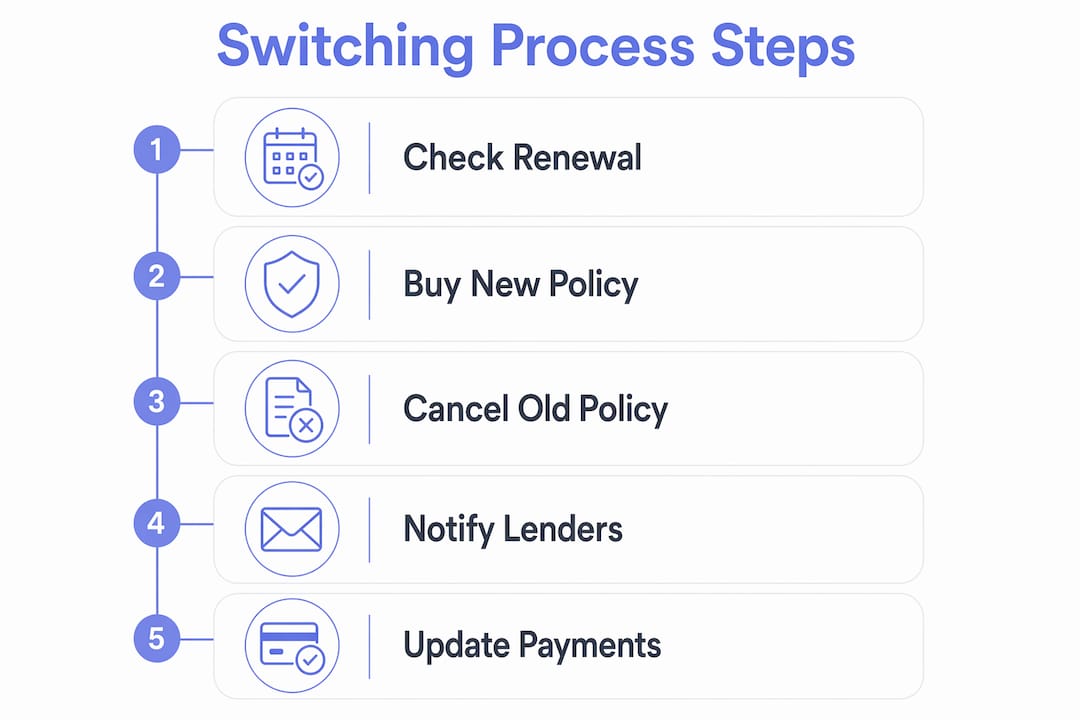
Confirm your renewal date and switch timing
Call your current insurer and get your exact renewal date. If that date is more than 30 days away, you can switch now and receive a refund for unused premium. If it falls within 30 days, schedule your new policy to begin on the renewal date. This one step eliminates cancellation penalties and maximizes your refund.
Purchase the new policy first
Sign your new policy and confirm the start date in writing before touching your old one. Unused premiums are typically refunded within 5–10 days after cancellation. Verify that your new policy’s start date matches the exact date your old policy will end.
Cancel the old policy officially
Contact your current insurer by phone and follow up in writing. Request a written cancellation confirmation with the effective date. Keep that document. If a billing dispute arises later, that confirmation is your proof.
Notify lenders and update records
| Notification Required | Who to Contact | What to Provide |
|---|---|---|
| Auto lender or leasing company | Finance company or dealership | New declarations page |
| Mortgage lender | Bank or servicer | New homeowners policy proof |
| Tennessee DMV (if required) | Local DMV office | Updated insurance card |
| Automatic payments | Bank or insurer | Updated billing information |
Lenders require proof of active insurance. Submitting your new declarations page the same day your new policy starts prevents any lapse notice from reaching your lender.
Update billing and payment information
Cancel any automatic payments tied to your old insurer immediately after cancellation is confirmed. Set up payments with your new insurer before the first due date. Proper billing coordination prevents accidental double charges and unintended lapses.
Common pitfalls when changing insurance providers
Most problems with switching come down to timing, discounts, and billing. Knowing the traps ahead of time keeps the process clean.
- Coverage gaps: Canceling before your new policy is active creates a gap. Even one day without coverage can raise future premiums and trigger legal issues in Tennessee.
- Discount loss: Multi-policy, loyalty, and accident forgiveness benefits do not follow you to a new insurer. Calculate what you lose before assuming the new rate is better.
- Refund assumptions: Not every cancellation produces a full refund. Short-rate penalties reduce what you get back. Confirm the method with your current insurer before canceling.
- Claims history: Switching insurers does not erase your claims record. New carriers review your history, and recent claims can raise your new premium or affect acceptance.
- Billing overlap: Failing to cancel automatic payments with your old insurer can result in charges from two companies at once.
Switching insurers requires realistic expectations. The financial benefits are real, but they depend on timing your cancellation correctly, accounting for lost discounts, and understanding that your claims history travels with you to every new carrier.
Drivers who switch every 6–12 months after rate increases or life changes often find better pricing. The key is doing it with full information, not just reacting to a lower quote.
Key Takeaways
Switching insurance companies saves money and improves coverage only when you buy the new policy first, confirm your renewal timing, and account for lost discounts and refund methods.
| Point | Details |
|---|---|
| Buy new policy first | Never cancel your old policy until the new one is confirmed active in writing. |
| Check your renewal date | If renewal is within 30 days, start the new policy at renewal to avoid penalties and maximize your refund. |
| Understand refund methods | Ask whether your cancellation triggers a prorated refund or a short-rate penalty before switching. |
| Account for lost discounts | Multi-policy and loyalty discounts do not transfer; recalculate your true savings before committing. |
| Update lenders and billing | Submit new proof of insurance to your lender and cancel old automatic payments the same day you switch. |
What I have learned after years of helping Tennessee clients switch
The clients who get burned by switching are almost never the ones who chose the wrong insurer. They are the ones who moved too fast. They saw a lower quote, canceled their old policy the same afternoon, and discovered three days later that the new policy had a start date mismatch or a missing endorsement.
The renewal date question is the one I ask every single time before anything else. If your policy renews in three weeks, there is no reason to cancel mid-term. Writing the new policy to start at renewal costs nothing extra and eliminates the short-rate penalty entirely. That is money back in your pocket with zero additional effort.
The discount math also surprises people. A homeowner in Germantown with a bundled home and auto policy may be getting a combined discount that does not show up as a line item on the bill. When they switch just the auto policy to chase a lower rate, the home premium goes up. The net result is sometimes a wash or even a loss. A good agent runs those numbers before recommending anything.
Treat the switch as a coverage review, not just a price exercise. The best outcome is better protection at a fair price, not the lowest number on a quote sheet.
— josh
Roman-insurance helps Tennessee drivers and homeowners switch the right way
Roman-insurance works with homeowners and drivers across West Tennessee, with deep local knowledge of the coverage needs common to high-value residential properties near the 38002 area. Whether you are reviewing your homeowners insurance or comparing auto insurance options, the team at Roman-insurance walks through your renewal date, your current refund terms, and your discount picture before recommending any change.

Roman-insurance represents Allstate home, auto, and life products, which means bundling options are available to replace the discounts you may lose when leaving your current carrier. Reach out to Roman-insurance for a side-by-side comparison built around your actual policy, not a generic quote.
FAQ
When should I switch insurance companies?
The best time to switch is more than 30 days before your current policy’s renewal date. If renewal is within 30 days, schedule the new policy to start at renewal to avoid short-rate cancellation penalties.
Will I get a refund when I cancel my old policy?
Unused premiums are typically refunded within 5–10 days after cancellation. The refund amount depends on whether your insurer uses a prorated method or applies a short-rate penalty, so confirm the method before canceling.
Does switching insurance affect my claims history?
Switching insurers does not erase your claims record. New carriers review your past claims, and recent incidents can result in higher premiums or affect your eligibility for certain discounts.
Can I lose discounts by switching insurance providers?
Multi-policy, loyalty, and accident forgiveness discounts do not transfer to a new insurer. Introductory rates from new carriers may also expire after the first policy term, so calculate your true long-term cost before switching.
How do I avoid a coverage gap when switching?
Purchase your new policy and confirm it is active in writing before canceling your old one. Verify that the new policy’s start date matches the exact end date of your old policy to maintain continuous coverage.