
Yes, you can file an insurance claim without a police report in most cases. Insurance companies generally do not require a police report to open a claim, but its absence shifts the burden of proof squarely onto you. What the adjuster actually needs is enough credible evidence to understand what happened, who was at fault, and what the damages are. A police report makes that easier. Without one, photos, witness statements, and medical records carry the weight instead.
Here is what that means in practice:
- Minor accidents, parking lot collisions, and no-injury fender benders are the most common situations where claims succeed without a report.
- A missing police report is a hurdle, not a wall. Adjusters must work harder to reconcile conflicting accounts, but they can and do approve claims without one.
- State laws vary on when a report is legally required, separate from what your insurer needs.
- California, for example, requires insurers to acknowledge claims within 15 days of notice and accept or deny within 40 days after receiving proof such as repair estimates.
- Your cooperation clause matters. Most policies require prompt reporting to your own insurer regardless of whether police were called.
Table of Contents
- When is a police report required vs. optional?
- How to file an insurance claim without a police report
- State variations and legal considerations you need to know
- Common challenges when filing without a police report
- How does filing without a report affect your approval odds?
- How insurance companies investigate claims lacking police reports
- How to handle disputes or denials tied to a missing police report
- Roman-insurance has you covered when claims get complicated
- Key Takeaways
When is a police report required vs. optional?
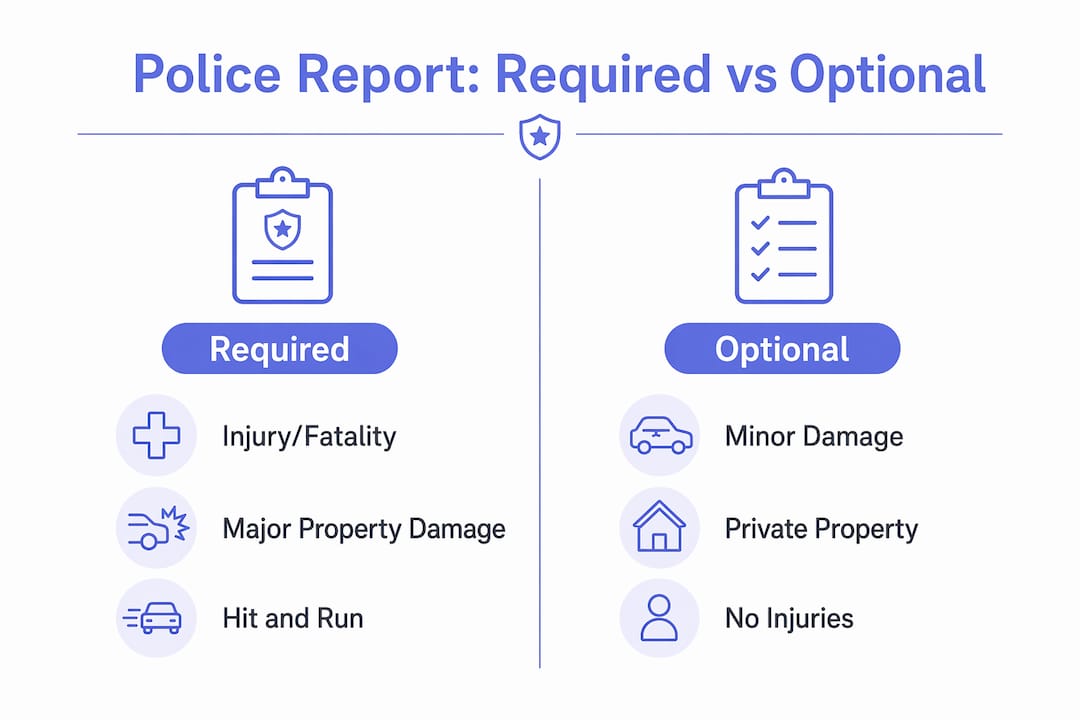
State laws, not your insurer, determine when a police report is legally mandatory. Most states require one when an accident involves injury, death, or property damage above a certain dollar threshold. Florida law, for instance, mandates reporting any crash resulting in injury, death, or property damage. Many states set similar triggers.
When a police report is typically required:
- Any accident involving injury or fatality
- Property damage exceeding your state’s reporting threshold
- A hit-and-run where the other driver fled
- Accidents on public roads where another driver disputes fault
When a report is usually optional:
- Minor parking lot collisions with no injuries
- Both drivers agree on what happened and exchange information
- Damage is clearly below your state’s mandatory reporting threshold
- The accident occurred on private property with no injuries
Even when optional, getting a report protects you. If the other driver later changes their story, a police narrative gives your insurer a neutral starting point.
| Scenario | Report Typically Required? |
|---|---|
| Injury or fatality involved | Yes, in virtually all states |
| Property damage above state threshold | Yes, varies by state |
| Hit-and-run accident | Yes, most states |
| Minor fender bender, both drivers agree | No |
| Private property, no injuries | No |
| Disputed fault, no injuries | Recommended but not always required |
How to file an insurance claim without a police report
The documentation you gather at the scene replaces what the police report would have provided. Do this immediately, before memories fade and before anyone leaves.
- Photograph everything: vehicle damage from multiple angles, license plates, road conditions, skid marks, and traffic signs.
- Get witness names and phone numbers. A neutral third party who saw the crash is one of the strongest substitutes for an official report.
- Exchange insurance cards, driver’s license numbers, and contact details with every driver involved.
- Write down your own account of the accident as soon as possible, including the time, location, weather, and the sequence of events.
- Collect repair estimates and, if anyone was hurt, medical records and bills.
- Report the accident to your insurer promptly. Delayed notification gives the carrier grounds to complicate coverage.
Pro Tip: Before giving any recorded statement to the other driver’s insurer, call your own agent first. Recorded statements can be used to shift liability or reduce your payout, even when you believe you are simply telling the truth.
If police were called but declined to file a report, document that interaction. Note the officer’s name, badge number, and the reason given. That record can still support your claim and demonstrates you made a good-faith effort to involve law enforcement.
State variations and legal considerations you need to know
State reporting rules create two separate obligations that drivers often confuse. The first is whether you must call police. The second is whether you must file a report with your state’s DMV, and those two duties do not always overlap.
California requires drivers to file an SR-1 form with the DMV within 10 days if damage exceeds $1,000 or anyone was injured, regardless of whether a police report exists. Skipping that step can result in fines and license suspension. Georgia and Florida have their own thresholds and forms. The details differ, but the pattern is consistent: failing to meet your state’s reporting duty creates legal exposure that is entirely separate from your insurance claim.
Critical steps that vary by state:
- Check your state’s property damage threshold for mandatory police notification.
- Confirm whether your state requires a separate DMV self-report form.
- Know your state’s deadline. California’s SR-1 window is 10 days; other states differ.
- Understand that late police reports or DMV self-reports may still be available in some states, even after the fact.
California insurers must acknowledge your claim promptly and resolve it within a reasonable period after receiving proof, as noted earlier. Other states have different timelines, and some have no codified deadline at all. Knowing your state’s rules before you file puts you in a stronger position from the start. Tennessee drivers can find guidance on local claim processes that reflects state-specific requirements.
Common challenges when filing without a police report
Adjusters scrutinize claims without police reports more closely, primarily because fraud risk rises when there is no official record. That is not a personal judgment against you. It is standard practice, and knowing it helps you prepare.

The biggest practical problem is disputed fault. Without a neutral police narrative, the adjuster is left weighing your account against the other driver’s, and those accounts rarely match perfectly. Dashcam footage, if you have it, cuts through that dispute faster than anything else. Timestamped photos are the next best thing.
Pro Tip: Write your personal account of the accident within an hour of the crash, before you talk to anyone else. Include every detail you can recall: speed, direction, road conditions, what the other driver said. A detailed, early written account is harder to challenge than a memory reconstructed days later.
Common pitfalls to avoid:
- Waiting days to report the claim, which raises questions about why you delayed.
- Giving a recorded statement to the other driver’s insurer without consulting your own agent first.
- Assuming consistent damage photos are enough when injuries are also claimed.
- Failing to follow up on witness contacts before they become unreachable.
How property condition and documentation affect claim valuation applies here too. Adjusters use the physical evidence you provide to anchor their assessment when no official report exists.
How does filing without a report affect your approval odds?
A missing police report does not automatically reduce your payout or trigger a denial. What it does is remove one layer of independent verification, which means every other piece of evidence carries more weight. Claims where both drivers agree on the facts and the damage is clearly documented tend to move through without much friction. Claims where fault is disputed and documentation is thin are where the absence of a report genuinely hurts.
The cleaner your evidence package, the closer your odds get to a claim backed by a full police report. Adjusters are looking for a consistent, believable account of the accident. Give them that, and the missing report becomes a footnote.
How insurance companies investigate claims lacking police reports
When no report exists, the adjuster builds the file from scratch using your photos, the other driver’s statement, witness accounts, vehicle damage assessments, and any available surveillance footage. They may request a recorded statement from you and conduct an independent inspection of both vehicles. Medical records become especially important if injuries are claimed, since the timeline of treatment helps establish that the injuries are connected to the accident.
Officers sometimes decline to file reports for minor, no-injury accidents on private property. Adjusters know this and do not automatically treat a missing report as suspicious. What they look for is internal consistency: does the damage match the described collision? Do the witness accounts align with yours? Does the medical timeline make sense?
How to handle disputes or denials tied to a missing police report
If your claim is delayed or denied because no police report exists, you have options. Start by requesting the denial in writing and asking the adjuster to specify exactly what evidence is missing. That tells you precisely what to gather next.

File a late police report or DMV self-report if your state still allows it. Even a report filed days after the accident can help document the incident and reduce the insurer’s uncertainty. If the other driver is disputing fault and you have witness contacts, get written statements from those witnesses and submit them formally to your insurer.
When a denial stands and you believe it is unjustified, contact your state’s department of insurance to file a complaint. Insurers are required to handle claims in good faith, and a documented pattern of unreasonable denials is something regulators take seriously. An attorney who handles auto accident claims can also review your file and advise whether the denial holds up under your state’s law.
Roman-insurance has you covered when claims get complicated
Dealing with an accident claim is stressful enough without wondering whether your policy actually has your back. Roman-insurance, serving West Tennessee and the greater Memphis area, works with Allstate to give local drivers auto insurance coverage built for exactly these situations: clear claims support, local expertise, and a policy that does not leave you guessing when something goes wrong.
Whether you are sorting out a fender bender or navigating a more complex claim, having an agent who knows Tennessee’s reporting rules and your specific policy makes a real difference. Roman-insurance also offers full coverage options for drivers who want the strongest possible protection before an accident happens. Reach out to Roman-insurance directly to review your current coverage and make sure you are prepared.
Key Takeaways
Filing an insurance claim without a police report is possible in most cases, but your evidence must be thorough, consistent, and submitted promptly to your insurer.
| Point | Details |
|---|---|
| Reports are not always required | Insurers can open and approve claims without a police report, especially for minor accidents. |
| State laws add separate duties | Some states require DMV filings within days of an accident, independent of your insurance claim. |
| Evidence replaces the report | Photos, witness statements, medical records, and a written personal account carry the most weight. |
| Adjusters look for consistency | Claims without reports face closer scrutiny; a coherent, documented account is your strongest asset. |
| Roman-insurance supports local drivers | Roman-insurance provides Allstate auto coverage and local claims guidance for West Tennessee drivers. |